Designing a kitchen without first learning the software
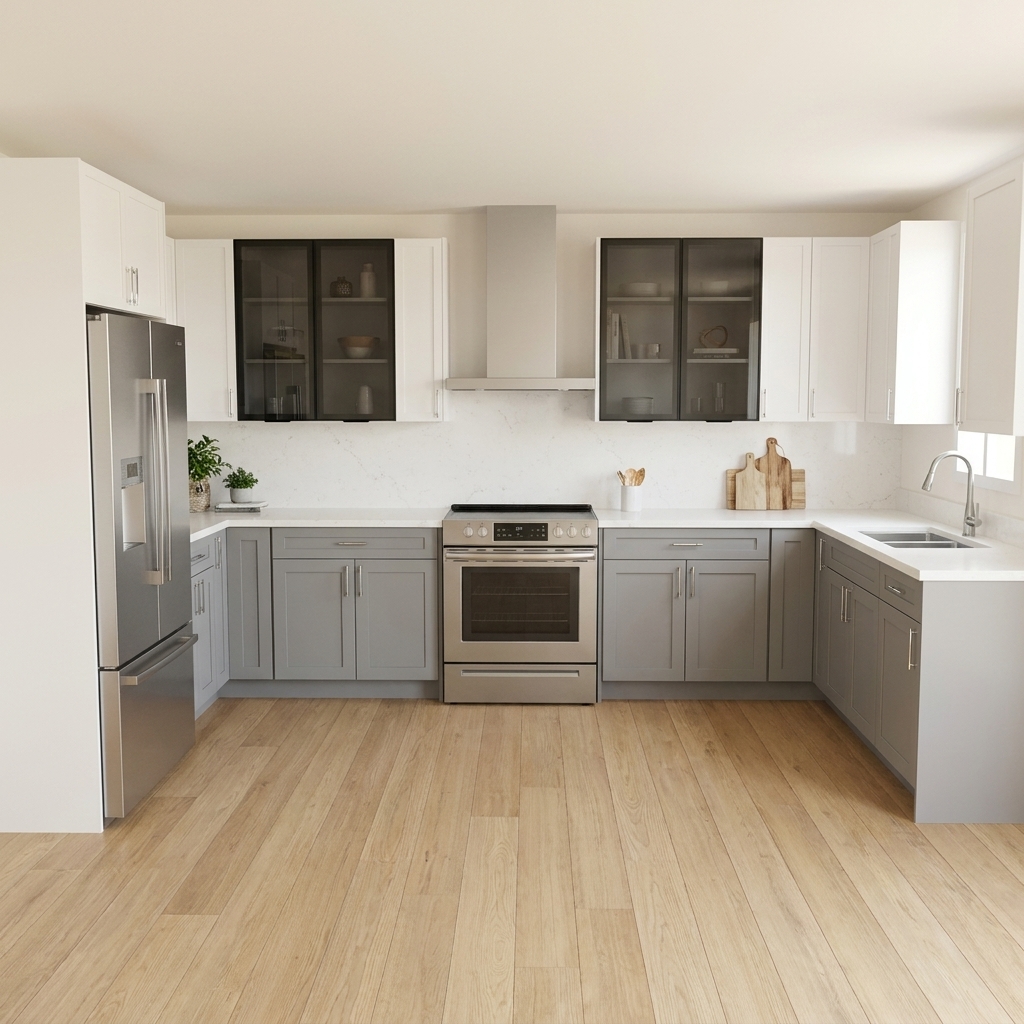
Most people who abandon a kitchen planner do not abandon it because the kitchen is hard. They abandon it because the software is: a toolbar of unlabelled icons, a vocabulary nobody taught them, and no way to ask what they are looking at. Flip Kitchen's free 3D planner now lets you ask out loud instead — including the one question a help page can never answer, which is what you should do next in your particular half-finished room. The two-tone kitchen here, grey Shaker below and white above with black-framed glass uppers, is about a dozen spoken decisions from an empty rectangle.
The barrier was never the drawing
Watch somebody use a kitchen planner for the first time and the sticking points are remarkably consistent. They cannot make a cabinet move and do not know whether the tool is switched on, whether the item is locked, or whether it is snapping to something they cannot see. They do not know what the narrow strip beside the fridge is called, so they cannot search for it. And they get a run of base cabinets in, look at the room, and stall — not because they lack taste, but because nobody has told them that the next decision is where the sink goes.
None of those are drawing problems. They are all questions, and until recently the only place to put a question was a help page written by somebody who already knew the answer.
The assistant in the planner is a different shape of answer, because she can see the state of your screen. Not a picture of it — the planner hands her a short written statement of what is actually there: which view you are in, the room's walls and ceiling heights, which item is selected with its code, its size, its wall and its height off the floor, any overlap warnings, and the last few things you did. So "why won't this move?" gets answered with your cabinet and your reason, rather than with a list of six things it might be.
"What should I do next" is not the language model
The most useful question in the whole tool is also the one people are most embarrassed to ask, and it is worth knowing that it does not go to the language model at all.
Ask what to do next and the planner runs its own step planner over your real layout — the same deterministic logic behind the on-screen suggestions — and comes back with exactly one of two things: a concrete recommendation naming a cabinet and where it goes, or the single question it needs answered before it can recommend anything. The assistant reads that out in plain language and asks whether you want it placed.
That distinction matters more than it sounds. A model asked to invent a next step will always produce one, confidently, whether or not it fits. A planner that knows the width of the gap either has an answer or has a question, and saying "I need to know where your sink is going first" is a better answer than a plausible cabinet that does not fit.
The vocabulary problem, solved by asking out loud
Cabinet language is the real entry fee to this hobby. Filler, scribe, reveal, blind corner, end panel, toe kick, stile. Every one of those is a thing you must name before you can search for it, and none of them are words a homeowner has any reason to know.
Asking out loud costs nothing and — more importantly — teaches the word in context, attached to the object in front of you. "What is that narrow strip next to the fridge for?" is a sentence anybody can produce. It returns the word filler, the reason it exists, and the fact that without one the last door in the run opens straight into the wall.
Product and how-to answers are grounded in the written DIY guide on this site rather than improvised, and when the lookup comes back with nothing relevant she says she is not certain and points you at a human instead of filling the gap. That is a deliberately unglamorous behaviour, and it is the one that decides whether the answers are worth anything.
When to stop talking and use the mouse
Voice is not a better mouse and it would be dishonest to sell it as one.
Dragging a cabinet to a spot you can see is faster than describing it. Comparing two door colours is a visual act, and she cannot see colour the way you can. Anything that needs a precise number in a specific field belongs in the field. And the kitchen still has to be measured by a person with a tape measure, in a room, before any of this means anything.
What voice is genuinely better at is the three things above: why something will not do what you expect, what a thing is called, and what to do next. Those are the three moments when a person gives up on a design tool, and they are all conversation-shaped rather than click-shaped.
What it costs you to try
Talking to the assistant is free outright on the Pro, Designer and Studio plans, and any other account gets thirty free minutes a day, resetting daily. Letting her edit the design while you talk is a separate mode you switch on, and it runs about half a GH Coin a minute. The Ask Emma button in the 2D toolbar tells you at a glance whether the microphone is live — it lights up green during a call, and unlit means nothing is being spent. Talking by voice is not recorded at all; the audio never reaches us and no transcript is kept.
If you would rather type, right-click the Ask Emma button and a typing panel opens instead, which needs no microphone and no free minutes. It answers questions but cannot change the design — and neither can a talking call, for the same reason: the editing tools are only handed out in editing mode.
Everything else in the planner remains what it was: a free browser tool that draws your real room, places real cabinets at the sizes that actually exist, shows the result in 2D, 3D and elevation, and lets you walk through it before anybody builds anything.