White vs. stainless chimney hood: the two-tone cabinet planning rule
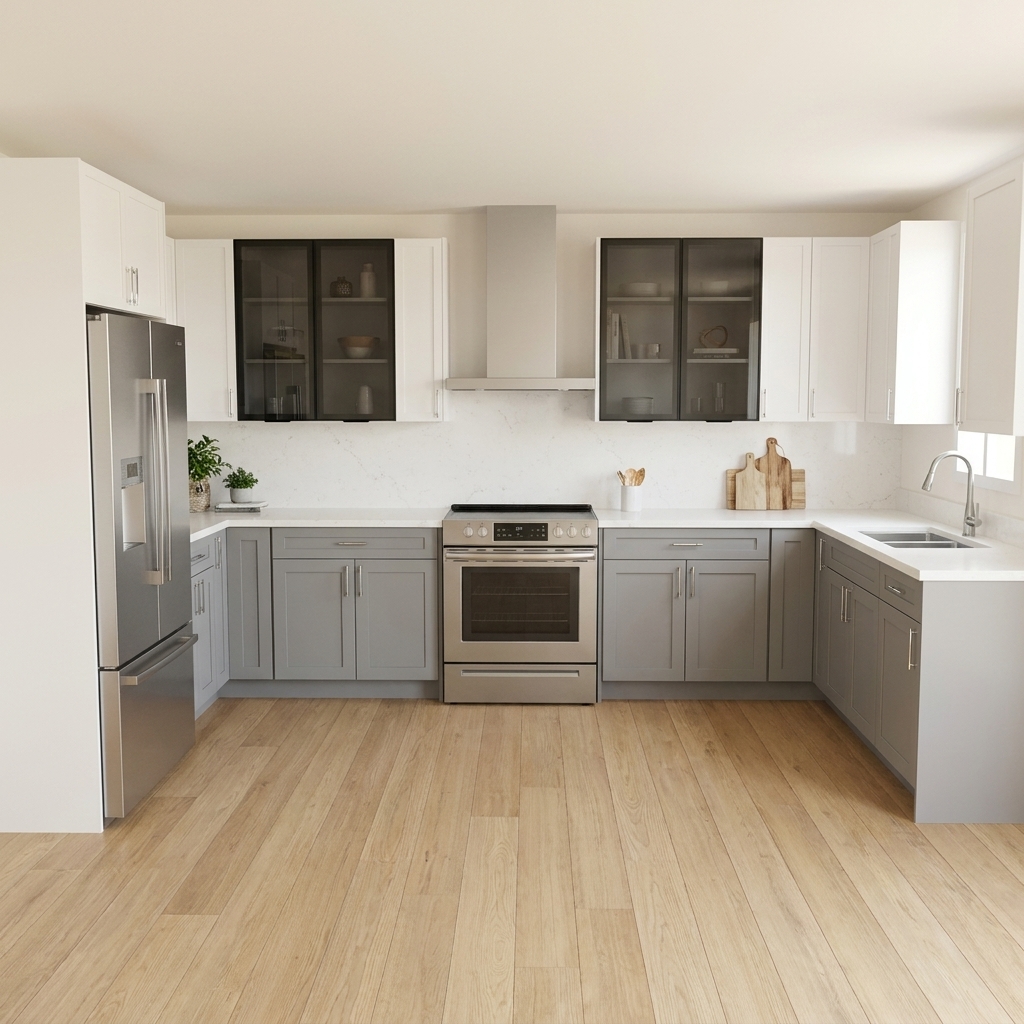
Livingetc reports that in 2026 two-tone kitchens, how you treat the range hood is the decision that reveals whether the design was planned holistically or assembled piece by piece. This kitchen shows the payoff of getting it right: white shaker uppers and a white-painted wall-mount chimney hood merge into one seamless zone above grey shaker lowers and a stainless freestanding range, while black-framed glass display uppers flank the hood on each side, adding depth without breaking the white upper field. But a matched white hood is not a simple substitution — it triggers specific cabinet order decisions around fillers, adjacent upper sizing, and door-swing clearances that a stainless hood never would.
Why the hood finish is a cabinet spec, not just an aesthetic choice
Most people decide on a range hood finish as part of appliance shopping, long after the cabinet layout is set. That order of operations is backwards: the hood finish directly determines what gets ordered for every cabinet within 18 inches of it.
When the hood is painted to match the upper cabinet colour — white, off-white, or a custom shade — the hood body visually merges with the upper cabinet field. The eye reads the cooking wall as one composition anchored by the chimney column, not a stainless appliance wedged between two cabinet runs. To make that work, the filler strips beside the hood body, the adjacent cabinet carcasses, and any return panels running above it to the ceiling must all be ordered in the same door style and finish as the flanking wall cabinets.
When the hood is stainless, none of that matching is required. The hood reads as an appliance, the same material family as the range and refrigerator. The trade-off: a stainless hood in an otherwise all-painted kitchen introduces a third material, which can look busy rather than intentional.
Standard chimney hood widths and the cabinet widths that sit beside them
Wall-mount chimney hoods come in standard body widths: 30, 36, 42, and 48 inches. The general planning rule — recommended by the NKBA — is that the hood should be at least as wide as the cooktop and, for best grease and vapour capture, up to three inches wider on each side. In practice: a 36-inch cooktop pairs cleanly with a 36-inch hood; adding a 42-inch hood for a 36-inch cooktop gives three extra inches of capture on each side without looking oversized.
The cabinet widths on either side of the hood must be chosen to fill the remaining wall width cleanly. On a 120-inch (10-foot) cooking wall with a 36-inch hood, you have 84 inches of remaining wall split between the two flanking cabinet runs. In the render shown, the two glass-front display uppers appear to be roughly 30 inches wide each, producing a balanced and symmetric arrangement with the hood centred above the range.
The chimney column above the hood body runs to the ceiling and is typically the same width as the hood body (or slightly narrower). It sits proud of the upper cabinet face plane by 2 to 4 inches — which is why the flanking cabinets must end before the chimney's side edge, not be pushed flush against it.
Filler strips: the spec detail that exposes a mismatched hood
Between a painted chimney hood body and the adjacent wall cabinet, there is almost always a gap — from wall irregularities, small differences in the chimney box depth, or the transition from the cabinet face frame to the smooth hood body. That gap requires a filler strip, typically 1 to 3 inches wide.
If the filler is a raw flat-panel board, it reads as a patch even when painted the same colour, because the board profile is flat while the adjacent shaker door has a recessed centre panel and profiled rail edges. The detail catches light differently. The solution is to specify the filler in the same door style as the upper cabinets — a shaker-profile filler strip in the same finish — so it reads as a narrow cabinet element rather than an afterthought.
A stainless hood handles the gap differently: the hood body typically has a small return lip or flange that overlaps minor wall gaps without requiring a separate filler. The material transition from stainless to a painted cabinet is a deliberate contrast, not a mismatch, so no finish-matching is needed. This is one of the few places where choosing stainless genuinely simplifies the cabinet order.
Glass-front display uppers flanking a white hood: clearance and placement
One reason the black-framed glass display uppers in this render work beside a white chimney hood is placement geometry. The display cabinets are positioned with their door hinge on the outer edge — meaning each door swings away from the hood chimney, not toward it. This is not accidental: a door hinged on the side closest to the chimney body would foul the chimney column when opened past about 60 degrees, making the display contents difficult to reach.
The rule of thumb: when placing glass-front or open-face display uppers adjacent to a chimney hood, orient the hinge so the door opens away from the chimney. A 30-inch upper cabinet door, fully open to 90 degrees, extends roughly 30 inches from its hinge point — well clear of a chimney column that protrudes only 4 to 6 inches past the cabinet face plane.
For clearance below the hood: NKBA guidelines recommend a minimum of 24 inches from the cooking surface to the bottom of the hood body for electric ranges. For gas, most appliance manufacturers specify 30 inches minimum from the grate surface to the hood bottom. Check your specific range manual, as some models require 36 inches. The render is consistent with the 30-inch standard.
When to choose white, when to choose stainless, and who should skip both
Choose a colour-matched painted chimney hood when: all the upper cabinets are painted (not a wood-grain finish), the refrigerator is the only prominent stainless surface in the kitchen and you do not want the hood adding a second large stainless element, and you want the cooking wall to read as one calm composition. The combination of white shaker uppers and a white chimney hood is particularly effective in a grey-and-white two-tone kitchen because the grey lowers carry the visual contrast — adding a stainless hood would compete with them for the eye.
Choose stainless when: built-in appliances with stainless surrounds are already in the kitchen, the cabinet finish is a wood grain or natural material that cannot be matched in a hood finish, or the hood is being added to an existing kitchen where matching the cabinet paint precisely would require repainting all the uppers.
Who should think twice about a painted hood: kitchens with heavy daily use over a gas range. Gas flames produce more moisture and grease particulate than electric or induction, and painted chimney hood interiors — the surface closest to the cooking — require more frequent cleaning and are more prone to yellowing over time. If the range is gas and the cooking volume is high, a brushed stainless interior with a painted exterior shell (available from some manufacturers) gives you the white exterior look with a more durable cooking surface.
How to plan this in the Flip Kitchen designer
In the Flip designer, place the wall-mount chimney hood over the cooktop position first. Confirm the hood body width matches or exceeds the cooktop width — the target is the cooktop width plus up to three inches per side for capture efficiency. Once the hood is placed, bring the adjacent upper cabinet runs to the sides of the chimney body, leaving at least two inches of clearance between the cabinet door edge and the chimney column.
Open the 3D view to check hinge clearance on the flanking glass-front display cabinets. Rotate the view to look directly along the cooking wall and verify that each display cabinet door, when open, does not foul the chimney body. Doors on the chimney-adjacent side should swing away from the hood; a door that opens toward the chimney typically needs to be mirrored — move it to the other side of the cabinet opening or choose a cabinet with the hinge on the far edge.
Run a Flip quote once the hood zone is finalised. The quote page lists every cabinet and filler panel by piece, so you can confirm the hood-side fillers are specified in the same door style and finish as the adjacent upper wall cabinets. That comparison is the clearest check that the white-matched hood spec is complete before the order goes in.