Cabinet Door Materials, Honestly Compared
We sell cabinet doors, so read this knowing that. Here are six door constructions as a refinisher and an installer see them — where each one shows its age first, what it forgives, what cannot be fixed — including the kinds we do not make.
Stand in a ten-year-old kitchen at four in the afternoon, when the sun comes in low and rakes across the cabinet fronts, and the doors tell you what they are made of. On the painted shaker doors there is a hairline crack in the paint at every joint, where each rail meets its stile — the same fine line in exactly the same place on every door. On the door beside the oven the vinyl skin has let go at the bottom corner and curled back like an old photograph. The flat melamine doors along the other wall look as they did the day they were hung, apart from one chipped corner. None of this is bad workmanship. Each door is doing what its material does — and once you know what that is, you can choose a door by how it will look in year ten, not in the showroom.
No door material wins everywhere. Solid wood is the one you can sand and refinish, but a painted five-piece wood door cracks its paint at the joints with the seasons. Painted MDF is the trade’s choice under paint, smooth and stable; its risk is water through a chipped edge. Thermofoil is seamless and easy to wipe, but it peels near heat and does not re-glue well. Melamine and laminate slabs have the toughest faces; their weak line is the edge band. High-gloss PET and acrylic wipe clean but show fine scratches. Veneer gives real wood on a stable core but takes little sanding.
Read a ten-year-old door before you buy a new one
The old doors in any kitchen are better evidence than a sample board. Look at them in a low side light — a phone torch held flat against the face does the job — and check six places. This is what a refinisher sees on a first visit, and the pattern repeats from house to house.
- The joint line on a painted five-piece door. Run a fingernail across the place where the top rail meets the stile. On a painted solid-wood door there is a hairline crack in the paint, and in winter perhaps a thin pale line along the edge of the centre panel, where wood that was never painted has slid into view. The panel floats in its groove and moves with the seasons; the paint cannot stretch, so it breaks. What it tells youThis is wood behaving like wood, not bad workmanship, and it comes back after every repaint.
- The thermofoil corner near the heat. Find the doors beside the oven and above the toaster or kettle. On a vinyl-wrapped door the trouble starts at a corner: first a faint bubble you feel more than see, then a lip you can catch with a nail, then a skin curling back over pale MDF and a crust of dried glue. A white foil door near heat has often drifted toward cream. What it tells youHeat, not age, ends thermofoil, and it always starts with the hottest door.
- A chipped edge or a lifted band on a slab door. Run a thumb along the bottom edges and corners of the flat doors by the sink and the dishwasher. The melamine face is nearly always perfect. The edge is where you find a chip from a pot or a vacuum head, or a band lifted a hair where steam reached it every evening. What it tells youOn a slab door the edge band is the weak line, and a thick band lasts far longer than a thin one.
- Fine scratches in a gloss face. Lower your head and look along a high-gloss door toward the window. A fine web of hairline scratches appears, thickest around the handle and at hip height. Straight on, under the ceiling light, the same door looks new. What it tells youGloss does not wear faster than matte. It shows more of what has happened to it.
- Worn finish at the handle and on the bottom edge. On the busiest door, paint goes dull around the handle, then thin, then shows primer at the nearest corner; stained wood lightens where fingers rub. The bottom edge of the sink doors takes wet hands and drips every day. What it tells youWear follows hands and water, onto two or three doors.
- The hinge side. A door that has dropped at the handle side has usually pulled a screw, and the heavy doors — tall ones, solid wood, thick MDF — get there first. What it tells youHeavy doors want a third hinge sooner, and screws snugged by hand.
Now notice what you did not find: a failure in the middle of any door. Every construction here is sound across its face. They part company at the edges, the joints, the corners near heat and the places hands go — so choosing a door material is really choosing which edge and which joint you would rather look after.
What they search at midnight “mdf vs solid wood cabinet doors” — the joint, the edge and the heat beside your oven tell you more than the word on the quote.
Six doors, side by side
| Door | Where it goes first | Heat and steam | Repair or refinish | Best for |
|---|---|---|---|---|
| Solid wood, five-piece | Paint cracks at the joints; panels move with the seasons | Tolerant of heat; dislikes water at the bottom edge | Yes — sanded and refinished, more than once | Stained or clear wood meant to last decades |
| Painted MDF | Chips at edges and corners; swells where water gets past the paint | Fine with ordinary heat; a chipped edge by the sink drinks water | Touches up easily; repaints well | Painted shaker and slab doors that should stay crisp |
| Thermofoil | Skin lifts and curls nearest the heat; white can yellow | Its real weakness | Not well — a lifted skin will not lie down again | A low-cost painted look, well away from ovens |
| Melamine or laminate slab | Edge band chips or lifts; the face rarely fails | Steam on the edge band, over years | Chips filled; a band re-glued if caught early | Flat doors in busy, practical kitchens |
| High-gloss PET or acrylic | Fine scratches that show against the light | Good on the face; the edge band is the joint | Light scratches often polish out | Modern flat doors in a household that wipes |
| Wood veneer | Thin face wears or sands through; edges dislike water | Moderate; depends on the finish over it | Light refinishing only | Real wood grain on a large, flat, stable door |
Look at where the lines meet. Every construction has one place where two different things are joined — a rail to a stile, a skin to a board, a band to an edge — and that join is where the door will age.
No prices here on purpose — they move with the supplier and the season. As a loose rule melamine and thermofoil cost least, gloss and painted doors sit above them, and solid wood and good veneer cost most. Ask for the numbers on your own plan.
Solid wood — and why a solid-wood door is not one board
Solid wood, five-piece
Best for stained or clear wood you may want to refinish one day
A solid-wood cabinet door is almost never a single board, because wide boards cup and split as the seasons change. It is a frame and a panel: two upright stiles, two cross rails, and a centre panel sitting in a groove in all four, deliberately left free to move. The shaker is its plainest form.
Its virtue is that it is the same material all the way through. Dents and worn patches sand out, and a tired kitchen can be stripped and refinished twenty years later. No other door on this page can be fully refinished.
- Can be repaired, sanded and refinished more than once
- Real grain, real depth, and the way wood ages
- Holds a hinge screw well in long wood fibre
- Moves with humidity; paint cracks at the joints
- Heavy, and some species darken or amber in daylight
- Costs most, and quality swings with species and grade
Here is what the word leaves out. Wood moves far more across its grain than along it. The stiles run up and down, so their length barely changes through the year; the rails run sideways, so their height swells and shrinks a little; and the centre panel, the widest piece of wood in the door, moves most of all — wider in a humid August, narrower in a dry February. A good maker leaves the panel loose in its groove, usually with small rubber spacers so it does not rattle, and never glues it. A panel that is glued, or locked in by thick paint, eventually splits.
That is why a painted solid-wood door cracks at the joints and a stained one seems not to. A stain soaks into the wood; when a joint opens a hair, the line is dark, runs with the grain, and your eye files it with all the other lines in the wood. Paint is one continuous skin. It bridges the joint and the panel edge, and when they move it breaks in a dead-straight line that, on a white door in a side light, is the first thing anyone sees. Repainting does not cure it; the next winter it opens again.
Species, in plain words: maple is pale, hard and smooth, paints well, stains unevenly unless prepared, and ambers slowly under a clear coat. Oak has open grain you can feel, stains beautifully, and shows through paint unless the pores are filled — the painting page has the method. Cherry darkens noticeably in its first years of daylight. Poplar is the trade’s paint-grade wood: soft, stable, with greenish streaks that never show under paint.
A great many painted “solid wood” shaker doors are solid wood only in the frame. The centre panel is MDF, because a flat MDF panel barely moves and never shows that pale strip in winter. That hybrid is a good door, not a cheat — but the rail-to-stile joints are still wood meeting wood, and they will still show a hairline under paint. If anyone promises a painted five-piece door will never mark at the joints, ask what it is made of, then ask what the warranty says.
The other quiet one is the bottom rail. The ends of the stiles are end grain, which drinks water like a bundle of straws, so a sink door wiped wet every evening darkens or lifts its finish there first.
Painted MDF — one name for three different doors
Painted MDF
Best for painted doors that should stay crisp and free of joint lines
MDF is wood broken down to fibre, mixed with resin and pressed into a board that is the same all the way through. It has no grain to show through paint, moves very little with the seasons, and machines to a sharp profile. That is why most painted cabinet doors are MDF, or at least have an MDF centre panel.
- The smoothest, most even paint surface there is
- Stable — far less seasonal movement than wood
- Chips touch up and the whole door repaints well
- Swells where water gets past the paint, especially at an edge
- Heavy — wants good hinges, well adjusted
- Chips at a corner on a hard knock
“MDF door” on a quote can mean any of three quite different things:
- One-piece, routed from a slab. The shaker recess is cut into a single ¾″ board. No joints, so nothing to crack. The tells: inside corners of the recess often slightly rounded where the bit turned, and routed surfaces a little coarser than the face, which need sealing before paint
- Five-piece with an MDF panel. A wood frame around a flat MDF centre — the hybrid in the callout above
- Five-piece, all MDF. Rails and stiles cut from MDF and glued. A joint line is rarer and finer than on a wood frame, though a hairline can still appear over the years
Ask a cabinet painter what they would rather spray and the answer is MDF: nothing underneath fights the paint. No grain to raise, no knots to bleed, no tannin coming through a white primer, no joint opening in February.
Its weakness is particleboard’s, which the box page covers in detail: water through a break in the seal. The painted face shrugs off a spill. But an edge chipped by a chair back, or the bottom of a sink door wiped wet for years, lets water into the fibre, and MDF swells there into a soft, rounded lip that does not go back down. Caught as a chip, it is a ten-minute touch-up; caught as a lip, it is usually a new door.
Thermofoil — a skin, and what heat does to it
Thermofoil (vinyl over MDF)
Best for a low-cost painted look, kept well away from heat
A thermofoil door starts as an MDF blank, routed to shape. A thin vinyl film is laid over it with a heat-activated glue and pressed under heat and vacuum, so the film is pulled tight over the face, down into every profile and around all four edges. It finishes in a seam on the back, usually against a plain white or beige backer.
New, it is genuinely good: seamless, no band to chip, no joint to crack, easy to wipe. Its whole life story is about heat.
- One seamless skin — no band, no joints
- Wipes clean and shrugs off everyday spills
- A painted look for less money
- Heat softens the glue and the skin lifts
- White foil can yellow over the years
- A lifted skin does not re-glue well and will not hold paint
The glue that holds the film was activated by heat in the press, and heat can soften it again. Nothing in a kitchen gets that hot at once, but the door beside a wall oven on a self-clean cycle, or above a toaster pushed against the wall, is warmed over and over for years. So the failure is always the same shape: a corner or an edge, nearest the heat, first.
Under a lifted skin the MDF is usually fine, but the film has stretched and no longer fits. Glue and a warm iron tack a small corner for a while; a lifted foil does not go back to being right, and paint over it only adds a layer to the thing letting go. The honest fixes are a replacement door or new doors on the existing boxes.
The trade answer is a heat shield: a strip fitted along the cabinet edge beside an oven or range that keeps hot air off the doors. Thermofoil makers supply them, and some of their warranties apply only where they are fitted. Ask for them on the order, not after the first corner lifts.
Not all thermofoil is the same film. Thicker, better foils tolerate more heat and hold their colour longer than the thin film on the cheapest doors. You cannot see that in a showroom, but you can open a display door, find the seam on the back, and press it: a seam already loose on a display door will be loose on yours.
Melamine and laminate slabs — the face is the easy part
Melamine or laminate slab
Best for flat doors in a kitchen that works hard
A melamine door is a flat board, particleboard or MDF, with a resin-soaked decor paper fused to each face under heat and pressure and a separate band glued to all four edges. High-pressure laminate is its heavier relative: a thicker sheet glued to the board, tougher again. Either way the face is hard, sealed, colour-fast and very difficult to scratch through, and a good modern decor carries an embossed texture that follows the printed grain, so it feels like wood as well as looking like it.
- A hard, sealed face that shrugs off spills and cleaning
- Colour stays the same door to door and order to order
- Usually the least expensive door that wears well
- The edge band is the weak line
- A chip cannot be sanded out; it is filled
- Flat only — no profile can be cut into the face
On a melamine door, forget the face and look at the edge, because the edge band is the door’s whole weak line. Behind it is ordinary particleboard or MDF, and if steam gets in under the band, it swells exactly as the box panels do.
Thin and thick bands are different products. A thin band — a tape well under a millimetre — follows the edge like a sticker, chips the first time a pot catches it and lifts where steam reaches it. A thick PVC band, a millimetre or more with rounded corners, behaves like a bumper. A fingertip tells them apart: a thick band has a soft, rounded corner; a thin one is sharp and square.
On a well-made door the glue line between band and face is a hairline you have to hunt for; a dark line visible across the room is often where a band starts to lift. Re-gluing a band and filling a chip is cheap while the board behind is still dry and hard.
High-gloss PET and acrylic — what scratches them and what does not
High-gloss PET or acrylic on MDF
Best for modern flat doors in a household that wipes
A modern high-gloss door is a plastic sheet laminated to an MDF core — PET, the same family of plastic as a clear drink bottle, or acrylic. The sheet is many times thicker than a melamine skin, which is where the depth of reflection comes from, and the edges are banded to match. Lacquered high gloss, sprayed and polished paint, is an older route to the same look and behaves like a painted door.
- Deep, even gloss that bounces light round a room
- Wipes clean in one pass
- The face shrugs off moisture and household cleaners
- Shows fingerprints, dust and fine scratches against the light
- A deep scratch cannot be sanded out
- The edge band is still a joint
What scratches gloss is grit, not use: dust dragged by a dry cloth, a scouring sponge, a belt buckle, a ring. Water, grease and ordinary cleaners do it no harm. So never dust a gloss door dry; wipe it with a damp microfibre and dry it in straight lines. Light surface scratches often polish out with a plastic polish; the care page has the routine for each surface. Between PET and acrylic, the differences are smaller than the sales talk suggests — both scratch under grit and both polish lightly — so judge the door in front of you, not the plastic’s name.
Gloss is honest about the installation in a way no other door is. Every door is a mirror, so a door a millimetre out of plane with its neighbour shows twice: once in its own edge, and again in the reflection of the next door bending at the seam. An installer hanging a gloss kitchen spends noticeably longer on hinge adjustment and sights along each run from the end, low down, like sighting along a plank. If your gloss doors look “wavy,” it is almost always the hanging. And peel the protective film once the dusty work is done; film left on for months, especially in sun, can be hard to get off cleanly.
Wood veneer — real grain on a core that stays put
Wood veneer
Best for real wood grain on a large, flat, stable door
A veneer door is a sheet of real wood, usually well under a millimetre thick, glued to each face of an MDF or particleboard core, with an edge of matching veneer or thin solid wood. The core does not move, so a veneered slab can be large and dead flat; the face is wood, so it has real grain and ages like wood.
- Real wood grain and colour on a flat door
- Stable core — no seasonal joint lines, wide doors stay flat
- Grain can run on from door to door across a whole wall
- Thin face — sand through it once and there is no repair
- Edges and the bottom of a door dislike standing water
- Like solid wood, shifts colour in sunlight
In good hands veneer is the most beautiful door on this page. The best makers keep the veneer for one kitchen in sequence from the same log, so the grain runs on from door to door. Ask whether the doors are sequence-matched; if not, every door has a different personality, which suits a rustic kitchen and looks odd in a minimal one. You will also meet reconstituted veneer: real wood sliced, dyed, re-glued into a block and sliced again, so every door is uniform — real wood, more regular than any tree.
Two cautions. Water at an edge: veneer that lifts at a bottom corner after a summer of wet cloths will not press back flat. And sanding: a veneered door can be scuffed and given a fresh clear coat, but one careless pass with a sander on a corner goes through to the glue, and there is no hiding it.
The finish itself — sprayed, brushed, and what sheen hides
On a painted or wood door, half of how it ages is the finish, not the board. A factory finish is sprayed in a booth with the door off its hinges, every face and edge coated, and cured — often with heat or a catalyst — into a film much harder than anything in a tin. A finish brushed on site is softer, thinner at the edges, often skipped on the back, and takes weeks to reach full hardness; hung too early, it sticks to the bumper and keeps the mark.
Pressed faces — melamine, laminate, thermofoil, PET and acrylic — have no finish in that sense. The face is the finish, identical on every door, which is also why a laminate colour matches from one order to the next far more closely than paint does.
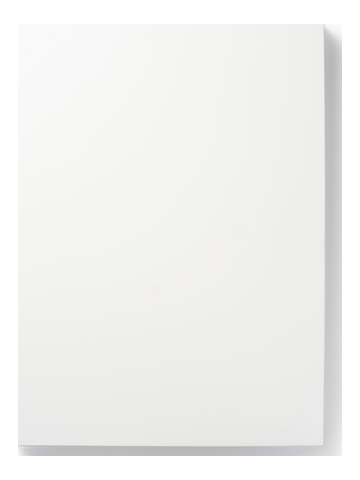

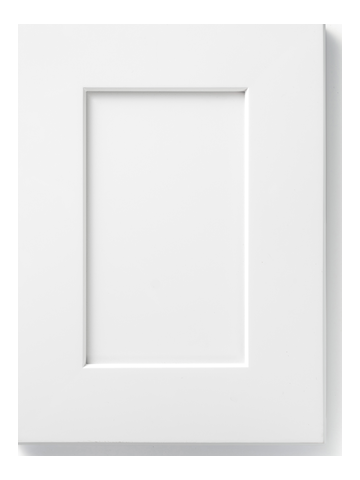
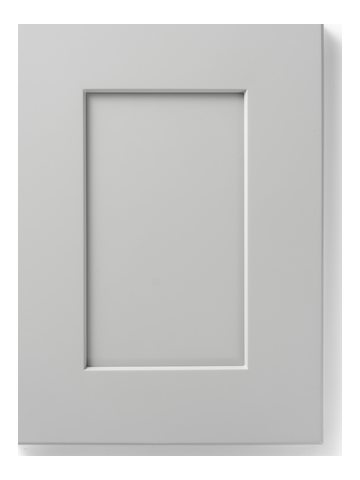
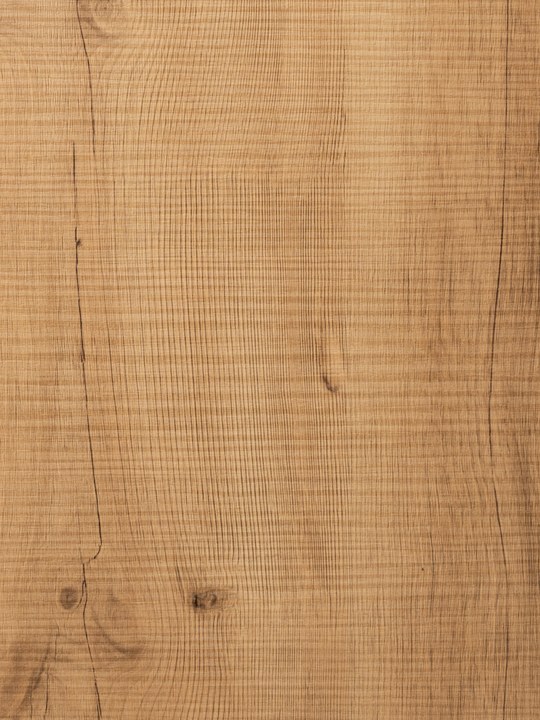
Those are six of our own door faces. The matte white hides fine scratches and shows grease as a faint shine where a hand lands. The gloss white hides nothing in a side light but wipes clean fastest. The shakers collect grime in the inside corners of the frame. The textured oak is the most forgiving face here: its grain and texture swallow fingerprints and small scratches.
A rule of thumb from anyone who cleans kitchens for a living: flat sheens show grease, high sheens show scratches, and texture shows neither. Super-matte faces sold as fingerprint-proof dislike oil and pressure — rub one spot hard and it can burnish to a permanent shine. The colour page covers what each sheen does to a colour.
How each door ages: a week, a winter, ten years
The first week tells you about the installation, not the material: a door that rubs its neighbour, a gloss door still in its film, a site-painted door hung before it cured. Adjust the hinges now, before rubbing wears through anything.
The first winter is when painted wood speaks. The heating dries the air, and somewhere in January a hairline appears at a rail joint on a few doors, then on most. Under a fingernail it is a line, not a step. Cherry and maple start to deepen in colour.
Years one to three are about knocks. On painted MDF a chip is a small crater with pale fibre in the bottom; on melamine, a clean nick with a sharp edge. Thermofoil usually still looks perfect.
Years five to ten are about heat and hands. The thermofoil door beside the oven shows a bubble that springs back under a thumb, then a lifted corner. Paint is thin around the busiest handles; gloss has its web of scratches at hip height. On melamine, the band beside the dishwasher may have opened a hair: if the board behind is still hard under your nail, a re-glue saves it; if it feels soft and rounded, the swelling has started.
At ten years and beyond, doors kept dry and cool are still flat and sound across the middle. Solid wood can be refinished, painted MDF repainted, veneer recoated; melamine and gloss stay as they are. Thermofoil near the heat is usually the first door in the kitchen to be replaced, and often the only one.
Whichever door you choose, these habits are worth more than the upgrade:
Order one spare door or a touch-up kit with the kitchen. Same colour, same batch, kept in the basement; a touch-up pen bought on day one matches better than one bought in year eight. Keep heat off thermofoil. Fit the maker’s heat shields beside the oven, and pull the toaster and kettle forward from under the wall cabinets when they run. Bumpers and hinges before anything rubs. Soft bumpers on every door and drawer front, and a quarter-turn of hinge adjustment the moment two doors touch — a rubbing door wears through paint at the edge in months. Never hang a wet tea towel over a door. It holds water against the top edge for hours a day, exactly what lifts a band, a foil or a veneer. Wipe the bottom edge of the sink and dishwasher doors dry whenever you wipe the counter above them.
And when you tighten anything, do it by hand: hinge screws and handle screws strip far more often from a drill than from use.
Six things the door material does not decide
Much of this argument blames the door for things it has nothing to do with.
- Whether the doors stay lined up. That is the hinges, the flatness of the box side, and whether the run was installed level.
- How the drawers feel. That is the runners. The front is a door; the smooth, quiet glide is hardware underneath it.
- How long the kitchen lasts. Doors are the easiest part to replace. Whether the kitchen lasts is decided by the boxes behind them and by water.
- Whether the colour will date. A good material in a colour you tire of is still a door you want to replace; choosing a colour is its own decision.
- Whether grease comes off. The sticky film by the stove lands on every door. Sheen changes how much you see it; wiping changes how much there is.
- How quiet the kitchen is. Soft-close hinges and bumpers do that. A heavy solid door with no damping closes louder than a light melamine one with it.
And one piece of language to watch for: “real wood doors.” It can mean solid wood throughout, a solid frame around an MDF panel, or veneer on a manufactured core. All three are honest products, and they behave differently. Ask which, part by part.
How to tell what a door is, with the door open
From the front, thermofoil, painted MDF and painted solid wood can look identical. Open the door and look at three places.
- The edge. Grain running from the face round onto the edge, with end grain at the ends of the rails, is solid wood. A separate band with a fine line where it meets the face is melamine, laminate, gloss or veneer. Colour that runs over the edge with no line at all is paint or thermofoil
- The back. A back that matches the front is painted, solid or veneered. Colour that wraps the edge and stops in a seam about an inch in, against a plain white or beige backer, is thermofoil — that seam settles it. A coloured gloss front with a plain white back is a laminated gloss door
- The hinge-cup hole. The round 35 mm bore for the concealed hinge cuts straight to the core. Long fibres mean solid wood, a smooth even brown means MDF, coarse speckled chips mean particleboard
Then ask the questions that tell you more than the name does:
- What is the core, and what is the face? — two separate answers, every time
- Is the centre panel the same material as the frame?
- How thick is the edge band, and is it on all four edges?
- Is the paint factory-sprayed, on the back and edges too?
- For thermofoil: are heat shields supplied, and does the warranty need them?
- Can I order a spare door or a touch-up kit now?
- What does the warranty say about joint lines, yellowing and peeling? — a good warranty names each material’s known behaviour
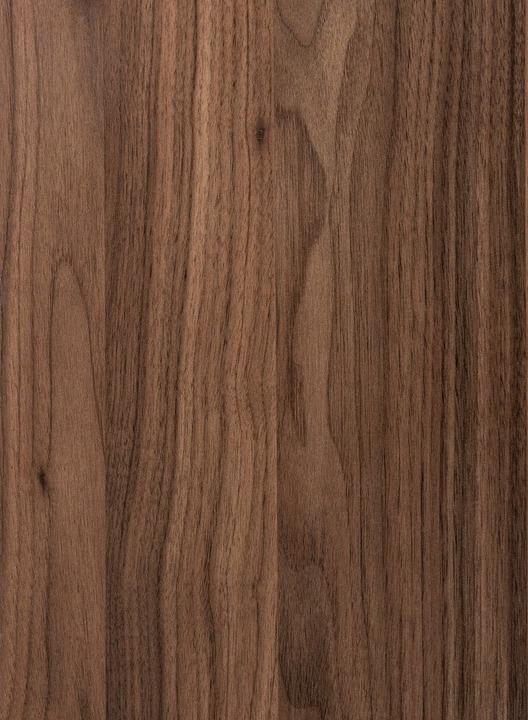
We sell doors, so weigh this paragraph accordingly. Flip doors come in three tiers, and they are different constructions rather than three prices of one door. Classic is four flat doors — Matte White, Bianca Wood, Walnut and Rustic Oak — with a 0.02 mm melamine face in the colour and texture, on an 18 mm particleboard core, edged in 1.3 mm PVC banding matched in colour and texture. Delight holds Glossy White — a 0.45 mm PET sheet on an 18 mm MDF core, with a white melamine back and the same 1.3 mm banding — and the shaker styles, White Shaker, Grey Shaker and Slim Shaker White, which are five-piece framed doors. Grand is the widest palette: matte and gloss solid colours, six wood textures, and the long list of laminate decors behind More colors in the planner. All of them are full-overlay doors on concealed, clip-on hinges.
Our range does not list a thermofoil door or a real-wood veneer door, and the Classic wood looks are melamine, not timber. If a stained solid-wood door or a veneer is what you want, use this page to buy one well elsewhere. For our shakers, the care page sets out what the warranty says about a hairline at a rail joint and how to get touch-up pens. Chapter 03 has the full spec tables; for the exact panel behind a particular door, ask us — a person will tell you.
What we would do, kitchen by kitchen
Here is how the choice falls for the kitchens people actually have.
A family kitchen in a house you plan to stay in. Painted MDF if you want colour; textured melamine or laminate if you want a door you never think about again. If you love real wood, have it stained, not painted: it hides its seasonal lines and can be refinished in fifteen years, which is the point of buying wood.
A condo. Flat doors, gloss or matte. A gloss slab bounces light round a small kitchen open to the living room; a matte one reads quieter from the sofa. Steady temperature and humidity are kind to every door, so pick on looks and cleaning habits.
A basement suite or a rental you own. Melamine or laminate slabs with thick bands. The hardest faces to damage, a chip is a wax-stick repair, and a single ruined door is quick to replace and matches.
A cottage, or anything left unheated in winter. Avoid solid wood, and painted five-piece doors above all; a building that swings from frozen and bone dry to warm and damp works every joint as hard as it can be worked. Melamine or laminate on a stable core is the calm choice.
A house you are fixing to sell. A crisp painted shaker or a clean flat slab in a current colour. Thermofoil looks just as good at the viewing, but with a wall oven the buyer inherits the first lifted corner within a few years, and an inspector who knows kitchens may say so.
A small kitchen. A pale gloss or satin slab with slim handles, and fewer, wider doors, does more for a small room than any upgrade in material.
Someone who cooks hard every day. A textured wood-look laminate or a matte painted door hides the most. No thermofoil within reach of the oven or the toaster, the thickest edge band on offer, and a towel bar where the tea towel would otherwise go over the sink door.
- You want painted doors that stay crisp. Painted MDF, factory-sprayed.
- You want real wood and to refinish it one day. Solid wood, stained or clear rather than painted.
- You want real wood on big flat doors. Veneer on a stable core, sequence-matched.
- You want the toughest everyday face. Melamine or laminate with a thick edge band.
- You want a modern mirror finish. PET or acrylic gloss, and a habit of wiping.
- The budget is tight and there is no wall oven. Thermofoil is reasonable; fit heat shields anyway.
If you already live with these doors
An hour with a cloth, a screwdriver and a torch catches most of this while it is still small.
- Find the hottest door. Check the corners beside the oven and above the toaster and kettle. On thermofoil, press any bubble; if it springs back, the glue has let go. Move the toaster and kettle to the front of the counter when they run, and ask the maker about heat shields.
- Take the tea towel off the door. Put up a bar or hook elsewhere. Dry the bottom edges of the sink and dishwasher doors and look closely: a soft lip on MDF or a lifting band is your early warning.
- Touch up the chips. A touch-up pen for paint; a wax fill stick for melamine, filled flush and then coloured. Do it while the core is still dry. The Fix chapter covers the other small repairs.
- Go round the hinges by hand. Snug every screw with a screwdriver, not a drill, adjust any door that touches its neighbour, and replace missing bumpers.
- Look at the gloss against the light. Damp microfibre, dried in straight lines; plastic polish on the light scratches, and leave the deep ones alone.
- Leave the joint lines alone. If your painted shakers have hairlines at the joints, do not fill them with caulk or filler — they will crack again and look worse. Keeping the indoor humidity steady through the winter keeps them small.
The rest of the kitchen has its own version of this decision: porcelain slab or quartz and quartz or granite on top, gas or induction for the cooktop, and a ducted or ductless hood above it.
Straight answers
Are MDF cabinet doors good?+
Yes, for painted doors they are usually the best choice. MDF has no grain to show through paint, moves very little with the seasons and machines to a crisp profile, so a factory-painted MDF door stays smooth and free of joint lines. Its weakness is water: if an edge is chipped and stays wet, the fibre swells into a soft lip. Touch up chips early and keep the bottom edges of sink doors dry.
Is MDF or solid wood better for painted cabinet doors?+
For painted doors, MDF, or a five-piece door with an MDF centre panel. Solid wood moves with the seasons, so paint over a solid-wood door cracks at the joints and can show a pale strip at the panel edge in winter. Solid wood is the better choice for stained or clear finishes, where those movements are hidden in the grain and the door can be sanded and refinished later.
Painted vs thermofoil cabinets: which lasts longer?+
Away from heat, both can last many years. Near an oven, toaster or kettle, painted MDF lasts longer, because thermofoil’s glue softens with repeated heat and the vinyl skin lifts at the hottest corner. A painted door chips but touches up; a peeled thermofoil skin cannot be glued back properly or painted over, so the usual fix is a new door. Heat shields beside the oven help thermofoil a great deal.
What is the difference between melamine and thermofoil?+
Melamine is a hard decor paper fused flat to each face of a board, with a separate band glued to every edge, so the door is flat and its weak line is the edge band. Thermofoil is a soft vinyl film pressed over a routed MDF door, wrapping the face and edges in one piece and ending in a seam on the back. Melamine chips at an edge; thermofoil peels near heat.
Can peeling thermofoil cabinet doors be fixed?+
Not well. Once the vinyl has lifted, the glue under it has been cooked and the film has usually stretched, so it will not lie flat again. Glue and a warm iron can tack down a small corner for a while. Painting over it does not help, because the vinyl lets go of the board and takes the paint with it. The lasting fixes are a replacement door or new doors on the existing boxes.
Why does the paint crack at the joints of my shaker cabinet doors?+
A five-piece shaker door is a frame of rails and stiles around a centre panel, and wood swells and shrinks across its grain with the seasons. Paint is one continuous film over the joints, so when the parts move it breaks in a fine straight line where each rail meets a stile. It is normal movement, not a defect. Steady indoor humidity keeps it small; filling it with caulk does not last.
Do high-gloss cabinet doors scratch easily?+
They show scratches more than they get them. A PET or acrylic gloss face is a tough sheet, but grit dragged across it leaves fine hairlines that catch the light, especially at hip height. Never dust gloss dry; wipe it with a damp microfibre and dry in straight lines. Light surface scratches often polish out with a plastic polish. A matte or textured door hides the same marks completely.
Is wood veneer as good as solid wood for cabinet doors?+
It is different rather than lesser. Veneer is real wood on a stable core, so a veneered slab stays flat, has no seasonal joint lines and can carry matched grain across a whole wall. What it cannot do is be sanded back and refinished like solid wood, because the wood layer is usually well under a millimetre thick. Keep standing water off its edges and it lasts as long as the kitchen.
How can I tell what my cabinet doors are made of?+
Open a door and look at the edge, the back and the round hinge-cup hole. Grain running onto the edge means solid wood. A separate edge band means melamine, laminate, gloss or veneer. Colour that wraps the edge and stops in a seam on the back means thermofoil. Inside the hinge hole, a smooth even brown is MDF, coarse chips are particleboard, and long fibres are solid wood.
Do MDF cabinet doors swell when they get wet?+
Only where water reaches the fibre. The painted or laminated face of an MDF door handles spills and wiping without trouble. If the paint is chipped, or an edge stays wet day after day, as the bottom of a sink door can, the MDF behind it swells into a soft, rounded lip that does not go back down when it dries. Touch up chips promptly and wipe the bottom edges dry.
See the door on your own kitchen.
Draw your kitchen once in the free planner, then try each door style and colour on it before you choose.
Open the 3D planner →