Quartz vs Granite, Honestly Compared
We sell quartz and do not sell granite, so hold us to saying where quartz loses — heat, sun and repair. Here is how each stone really ages in a working kitchen, where the marks gather, which ones come out again, and which kitchen each one suits.
Granite is chosen standing up. At a stone yard the slabs lean on edge in long steel racks, row after row, like giant books on a shelf, and no two pages are the same. You walk the aisle with a yard hand, tip a slab forward to see the one behind it, and wipe a wet sponge across its dusty face so the colour comes up the way it will look in your kitchen. When you find the one, he chalks your name on it. Quartz is chosen across town, sitting down, from a 4″ sample on a rack — and what arrives on the truck looks like the sample. One is a found object; the other is a manufactured one. Nearly everything else on this page, from stains to seams to what can be repaired in ten years, follows from that difference.
Choose quartz if you want a counter that never needs sealing and looks the same in ten years: it is non-porous, resists stains and comes in predictable colours, but its resin can scorch under a hot pan and yellow in strong sun, so it stays indoors. Choose granite if you want a one-of-a-kind natural stone that shrugs off heat and sun and can be re-polished: most slabs need sealing on a schedule that depends on the stone, lighter ones can stain, and you must approve the actual slab. Both are hard, both chip at an edge, and neither wears out.
Read a ten-year-old counter before you choose a new one
If you can, find a granite counter and a quartz counter that have each been cooked on for about ten years — a friend’s kitchen, the house you are leaving. Bend down until your eye is level with the surface, look along it toward a window, and run your fingertips across it. Any fabricator who repairs old tops will tell you the marks gather in the same handful of places, and the thing people worry about in the showroom — the knife — is not one of them.
- The halo around the faucet. Start with the granite. Around the base of the tap and under the soap pump, a lighter granite often has a darker patch with soft edges, like the shadow of a puddle. It feels exactly like the rest of the counter. Water that stood there every day has worked into the stone where the sealer wore away first, and after a dry weekend much of it fades, because water dries back out. If it is still dark after days, or darkest under the soap bottle, it is soap or oil, and that stays until somebody draws it out. What it tells youGranite records where water and oil stand, not where you cut. An open, light stone records it sooner, and a two-minute water test tells you when the sealer has gone.
- The film in front of the sink. Tilt your head until the window light skims across the strip in front of the sink. Many old granite tops have a dull, slightly smeary haze there that the rest of the counter does not. Usually it is not the stone at all: it is years of all-purpose spray, an oily “stone shine” product, or sealer that was never properly wiped off. Less often it is the polish itself, dulled by acidic or abrasive cleaners used every day. What it tells youMost of what makes old granite look tired is on the surface, not in it. A film comes off with the right cleaner; a dull polish can be re-polished in place.
- The pits and the hairlines. Run a fingernail slowly across an open stretch. Somewhere it will drop into a tiny pit, where a crystal — often a flake of dark mica — came loose when the slab was polished, or follow a fine line wandering between the crystals. If both sides of the line sit at exactly the same height and it follows the grain, it is a natural fissure, and it was in the slab at the yard. A crack that came later tends to cut across the grain, often from the corner of a cutout. What it tells youNatural stone comes with natural features. They are not wear and they rarely change — and the time to look for them is at the yard, with the slab in front of you.
- The edge by the dishwasher, and the seam. A small shell-shaped chip out of the front edge beside the dishwasher is the commonest damage on any stone counter, usually from a heavy pot or the machine’s own door. Then find the seam. On a stone with movement — sweeping bands or big clusters of colour — the pattern stops dead on one side and starts again differently on the other, and the joint reads as a line from the doorway. On a small, even granite you may have to hunt for it. What it tells youThe two things granite owners notice most are both made at an edge, one by impact and one by the saw, and both owe as much to the fabricator as to the stone.
- Beside the cooktop. Now the quartz counter. Most of it looks almost new. Beside the burners, on the side the pans come off, look for a pale or faintly yellow patch — a crisp ring the size of a pan base, or a broad, cloudy one where a slow cooker always stood. It feels like the stone around it. Nothing was removed; the resin changed colour. What it tells youQuartz does not wear; it gets marked, all at once, by heat. And it is the one mark on this page that nobody can polish out.
- The sunny end, the corners and the seam. On some colours, the end under a bright window has gone a shade warmer than the rest; you only notice when the fruit bowl that has sat there for years is lifted and leaves a cooler ghost. Then the same edges as granite: a small chip at a corner, and a seam whose filler has darkened a shade. What it tells youQuartz’s binder is a plastic the sun can reach, its seams are glue, and its edges are as brittle as any stone’s.
Now notice what you did not find. On neither counter is there wear: no path worn in front of the sink, no softened edge where hands rest, no knife lines where the chopping happens. Both are made largely of minerals harder than a steel blade, and neither fails in ordinary use. The whole comparison fits in one line: granite gets marked by what soaks in, quartz by what is hot — and nearly everything that marks granite can be taken out again, while a scorch on quartz cannot.
What they search at midnight “quartz vs granite countertops” — granite marks from what soaks in, quartz from what is hot. Pick the habit you would rather keep.
Granite and quartz, side by side
| Granite (natural) | Quartz (engineered) | |
|---|---|---|
| What it is | Natural crystalline rock — or one of several hard stones sold under the name | Ground quartz bound with resin and pigment |
| Hot pan | Tolerant; a trivet is still kind | Can scorch, permanently |
| Oil, wine, coffee left sitting | Open, light stones can stain; dense ones barely absorb | Resists stains |
| Lemon, vinegar | True granite does not etch; acids wear the sealer sooner | No reaction |
| Sealing | Depends on the stone — test, then seal if it darkens | Never |
| Knives and grit | Very hard; the knife dulls first | Very hard; the knife dulls first |
| Strong sun, outdoors | Colour stable; used outdoors | Resin can yellow or fade; indoors only |
| Every slab | Unique — approve the actual slab | Consistent within a batch; the sample is what arrives |
| Seams | Vanish in a small, even pattern; show in a bold, moving one | Easy in plain and speckled colours; veined designs need layout |
| When it is marked | Chips fill; a dull polish re-polishes; many stains draw out | Chips fill; a scorch does not come out |
| In ten years | Much as it was, darker where water stands if never resealed | Much as it was, except where heat or sun marked it |
No prices here on purpose. Neither one is reliably the budget choice: a common granite and a plain quartz can land close together, and both have premium tiers that cost far more. The spread inside each is wider than the gap between them. Quote the exact slab, the edge and the number of seams.
Granite — and why “granite” is not one stone
Natural granite
Best if you want a one-of-a-kind stone that takes heat, sun and hard use
Granite in the geologist’s sense is a rock that cooled slowly, deep underground, into a coarse interlocking mass of crystals — mostly feldspar and quartz, flecked with darker minerals such as mica. The crystals are what you see: the speckle, the clusters, the flash of colour when light catches a feldspar face. It is very hard, unbothered by heat and stable in sunlight, which is why it has been used for steps, sills and monuments for as long as people have cut stone.
The trade-off is that it is a natural crystalline stone, and between the crystals there are microscopic gaps. Most granite absorbs a little — how much varies enormously from one stone to the next — so it is sealed, and resealed when a simple test says so. And because it is cut from a block, no two slabs are alike: you choose a slab, not a name.
- Takes a hot pan without complaint
- Stable in sun; fine outdoors
- Re-polishable; chips fill and blend into the speckle
- Most slabs need sealing, some often
- Light, open-grained stones can stain from oil
- Bold patterns make seams hard to hide
Here is what the word leaves out. The stone trade uses “granite” for nearly any hard, crystalline stone that takes a polish and is not marble, and the name on a slab tells you less than five plainer facts about it:
- Which rock it really is. Many slabs sold as granite are geologically something else: gneiss with its swirling bands, gabbro and its dark cousins behind most black “granites”, and mixed stones with dramatic movement. They are hard silicate stones and mostly fine in a kitchen, but a few exotic slabs sold under the name carry softer minerals or veins that can etch. A drop of lemon on an offcut settles it
- How open the grain is. Porosity varies more than any brochure admits. Dense, fine-grained dark stones barely take up water, and some never need sealing. Light stones with big crystals — many of the whites, creams and pale golds — can drink a puddle in a minute and want sealing more often. Two slabs both called granite can differ more from each other than granite and quartz do
- What “level” it is. Yards sort granite into levels, groups or grades, and the higher ones cost more. Those tiers follow rarity, origin, demand and how hard the stone is to quarry — not durability. A first-level stone is often a common, dense, sensible granite; a top-level one may be a rare beauty full of fissures
- Whether it was resin-treated. Many slabs are treated at the factory: resin is drawn into the surface pores and fissures, cured, and the face then polished. It toughens the slab for handling, closes small pits and lowers absorption. That is normal practice, not a fake — but part of the polished face is then resin, and the label in the yard rarely says so. Ask
- Polished, honed or leathered. Polished granite shows colour and crystal at their deepest and resists stains best, because the polish closes the surface. Honed is ground to a flat matte that shows fingerprints, oil and water marks more and usually wants sealing more often. Leathered is brushed to a soft, slightly undulating sheen that hides fingerprints and water spots best — a favourite on dark stones — with a little more texture to wipe
The sponge at the yard is a test as well as a cleaner. Wipe a patch and watch it dry. A slab that stays dark for several minutes is an open stone that will need regular sealing; one that dries back in seconds is dense. It is the water test you will do at home, done before you buy.
The second thing fabricators know: sealing a dense stone can make it look worse. Sealer is meant to soak in. On a dark, tight granite that barely absorbs, it cannot, and what is left on the surface dries to a streaky haze — a good share of the “film” on old black counters is exactly that. A careful shop tests before it seals and tells you plainly when a stone does not need it.
And with very black slabs, ask whether the colour is natural. Some lower-grade dark stones are dyed to look blacker and more even, and the colour can fade where it is cleaned hardest. A little acetone on a cotton ball, rubbed on the underside of an offcut, picks up colour from a dyed slab and nothing from a natural one.
None of that is a reason to be nervous of granite. It is a reason to buy it the way stone people do: by the slab, with water, a fingernail and a few questions.
Quartz — one recipe, many products
Engineered quartz
Best if you want a counter you never have to think about — as long as heat stays off it
Quartz countertops are made, not quarried: crushed natural quartz mixed with a polymer resin and pigment, pressed into slabs and cured. The quartz gives it hardness; the resin fills every gap, so the slab is non-porous, resists stains and never needs sealing. The colour is designed, so the sample on the rack is what arrives, and a long run can be cut from slabs that match.
Its weaknesses all live in that resin. A hot pan or a long-running appliance can scorch it; strong sun can yellow or fade it, so it stays indoors; and harsh chemicals — oven cleaner, paint stripper, concentrated bleach — can mark it. The quartz care guide has the daily routine.
- Never needs sealing; very stain resistant
- Hard and scratch resistant
- Predictable colour that matches across a run
- Hot pans can scorch it, permanently
- Not UV stable — indoors only
- A scorch cannot be polished out
How quartz is made, and the ways one quartz differs from another, is laid out at length on the marble vs quartz page. The short version, with the parts that matter when granite is the other option:
- Resin and filler. Most of a slab by weight is ground stone; the small share of resin and pigment is what makes it non-porous, and it is also what heat and sun attack. Recipes vary between makers and lines, which is why each publishes its own heat and care rules. Read the ones for the slab you buy
- Speckled or veined. The older, simpler designs are particulate: an even speckle of grains in a tinted body, like the grey slab below. They hide crumbs, seams and small chips well, because the pattern runs through the whole thickness. Veined designs look richer and ask for more care at every seam and cut edge
- One run, not every run. Quartz is consistent within a production batch and close between batches, not identical. Cut the whole job from one batch, and expect a replacement piece years later to be close rather than perfect
- 2 cm or 3 cm. About ¾″ or 1¼″. The thicker slab is stiffer over an overhang and needs nothing under its front edge; the thinner one is often given a built-up edge to look heavier. Granite comes in the same two thicknesses
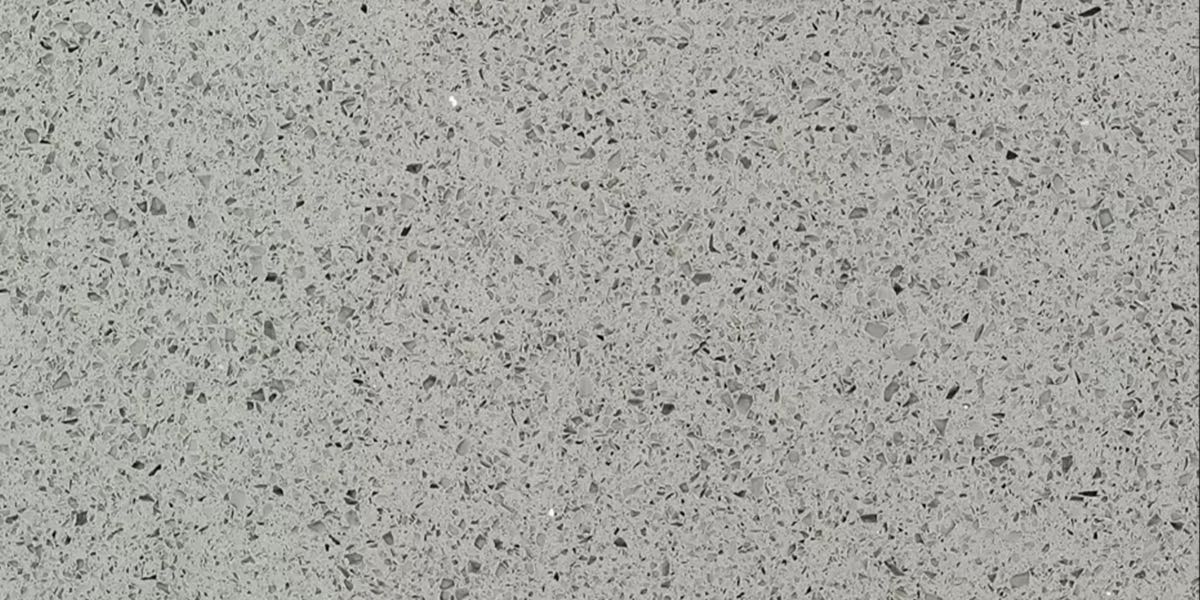
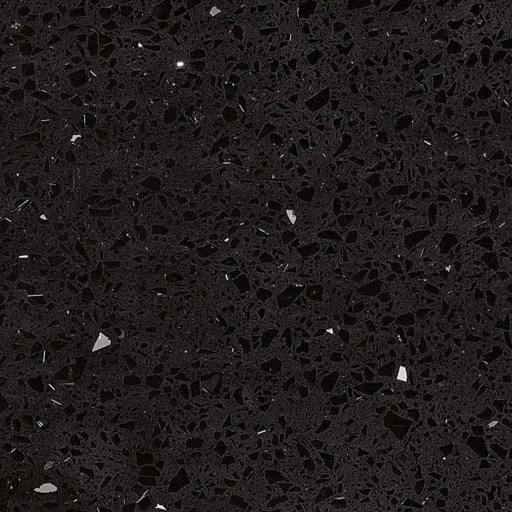
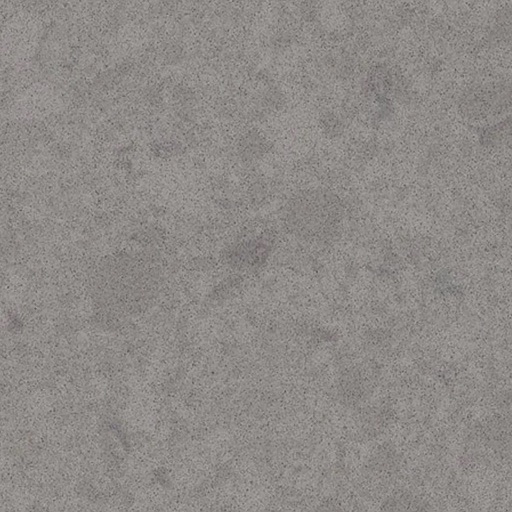

Not every quartz is pretending to be marble. Speckles, solids and concrete looks are where quartz is most itself. The plainer and darker the colour, though, the less it forgives: a solid charcoal shows dust, water spots, fine scratches and a pale scorch far more than a speckle does.
The surprise for quartz owners is rarely a stain. It is that a counter which shrugs off red wine can be marked in a minute by a pan. Granite owners get away with habits that quartz owners pay for: the roasting tray put down on the nearest bit of counter, the cast-iron pan slid aside, the oversized pot on a front burner that overhangs the cutout and heats the narrow strip in front of it.
The repair is where the gap shows. A chip in quartz fills well with tinted resin. A scorch does not lift, because the colour change is in the binder itself; the honest fix is to cut out and replace that section — which is why a labelled offcut of your own slab is worth a spot on a basement shelf.
What soaks in, what burns, and what sealer actually does
Heat first, because it is the clearest difference. Granite formed at temperatures no kitchen comes near, and a pan straight off the burner does nothing to the stone. Two small cautions: a very hot pan set across the narrow bridge in front of a cooktop cutout can crack any stone, natural or not; and on a resin-treated slab, the resin in the surface pores may not love heat. A trivet on granite is a kindness. On quartz it is the rule, every time, because the resin that binds the slab is the one part of either counter a pan can hurt.
Stains are absorption. Something coloured wicks into the pores and darkens the stone from below. On granite, everything depends on which stone. Water darkens an open stone and dries back out. Oil darkens it and stays, spreading slowly, because oil does not evaporate. Wine, coffee and the rust ring from a tin left overnight can mark a light, open granite; on a dense dark one, almost nothing gets in at all. Quartz has no pores worth the name: the spill sits on top until you wipe it.
What sealer is, and is not. A granite sealer is an impregnator: it soaks into the pores and sits there, invisible, so water and oil go in more slowly. It is not a coat on top, it does not make a stone stain-proof, and it wears away from the busiest spots first — which is why the halo appears around the tap and nowhere else. “Sealed” on a quote usually means one application at installation. Some sealers are sold with long-life claims; the water test is still the judge.
The water-drop test, done properly. Pour a small puddle beside the tap, where the counter works hardest, and another on a quiet spot along the back wall. Leave them a few minutes, up to a quarter of an hour, then wipe dry. No change: leave it alone. Darker by the tap only: that spot is ready for sealer. Dark within a minute or two: an open stone that wants sealing on a shorter schedule. Many fabricators suggest checking about once a year; the stone, not the calendar, decides.
Acids are the quiet one. True granite does not etch the way marble does — lemon and vinegar leave no dull ring. But daily vinegar sprays and acidic or harsh cleaners wear the sealer away sooner, and over years they can take the edge off the polish. A pH-neutral stone cleaner or a little dish soap does the job on both counters. Do not seal quartz. There is nothing for the sealer to go into, and what you wipe on stays on as a film.
How each one ages: a week, a year, ten years
The brochures show both counters on installation day. Here is the rest of the film, for a kitchen that cooks most nights.
Granite, the first week. A dark ring where a sweating glass of water stood through dinner, gone again by breakfast — the stone drying, not a stain. The first year. If the sealer was thin, the first shadow around the tap; if the wrong spray is in use, the first faint haze in front of the sink; perhaps a chip at the dishwasher. Ten years. The halo, the film and a filled chip or two, and the rest of the counter much as it was. Every one of those marks can be cleaned, resealed or re-polished; a stone restorer can take a tired granite top back to an even shine.
Quartz, the first week. Nothing. The first year. Usually still nothing. At most, a dull film in a busy spot from a cleaner that does not suit the resin, which the right cleaner takes off. Ten years. Most of the surface is as it was on day one, and that is the whole case for quartz. What has changed has changed in single events: a scorch beside the cooktop, a cloudy patch where an appliance lived, a chip on a corner, a seam a shade darker, and on some colours a warmer end under the window.
That is the real difference in temperament. Granite’s marks come from slow habits and can be undone; quartz’s come from single moments and stay. Which of those suits you says more about the way you cook than about the stone.
Under a fingernail. Granite is mostly feldspar and quartz, both harder than a steel knife, and the engineered slab is mostly quartz too, so neither takes knife marks in normal use. What a fingernail finds on granite are the natural pits; on quartz, nothing. The scratches either one does collect are fine swirls from grit dragged under a pot, and they show mostly on dark, plain, polished colours. On granite a fabricator can polish them out; on quartz the factory finish is hard to match by hand, so prevention is the plan.
Sun and the outdoors. Granite sits in sunlight on steps and monuments for generations without changing colour, and it is the usual choice for an outdoor kitchen. Quartz resin is not UV stable. Indoors, some colours can warm or fade over years where strong sun falls daily — usually the pale ones, under a south- or west-facing window. Outdoors, quartz does not belong at all, and its warranty will normally say so.
What can be fixed. The list is short, and it is the clearest place granite wins:
- A chip — both. A fabricator fills it with tinted resin and polishes it flush; on a speckle it all but disappears, on a plain colour it is easier to find
- A dull or scratched polish — granite can be re-polished in place; on quartz the factory polish is hard to reproduce
- A stain — on granite a stone poultice draws most oil stains back out; quartz rarely stains in the first place
- A scorch — granite does not get one; on quartz the section is replaced
- A crack — both can be filled and stabilised, and on both it stays visible. The cause is usually underneath: cabinets out of level, an unsupported overhang, a strip never reinforced
Slabs, seams, and what a good shop does without being asked
A granite sample is a colour family, not a promise. The same stone varies from block to block and often across a single slab, so you approve the slab, not the sample. Slabs cut from one block are numbered in sequence and kept together as a bundle; for a big kitchen, ask for consecutive slabs so the island and the perimeter look like the same stone. Then ask where each piece will be cut from. A good shop lays the pieces over a photograph of your actual slabs, or lays templates on the stone, so the heaviest cluster lands in the middle of the island and not in a sliver beside the fridge.
Quartz is chosen from the sample, and for plain and speckled colours that is the end of it. For a veined quartz, ask for the same layout, and for every piece from one batch.
Seams are where the two differ most to the eye. Both are joined the same way: pieces butted tight and the joint filled with a resin tinted to match. On a small, even pattern — a fine-grained granite or a speckled quartz — the two sides look alike and the seam is a hairline. On a granite with movement, the pattern cannot continue onto the next piece unless both were cut from neighbouring parts of the stone, so the seam reads as a line where the stone changes its mind.
Slab size, and the long island. Both stones come in slabs of very roughly ten feet. Quartz is made in a standard size and, for many colours, a larger “jumbo” one; granite comes as big as its block allowed. A run longer than the slab needs a seam, and so does an island deeper than the slab is wide — a seam down the length of an island, the worst place for one. Measure the island against the actual slab, and if it is very large, porcelain slabs come larger still. Overhang and seating sizes are in the island guide.
Underneath, the cabinets do not care which stone you pick: the two weigh much the same for the same thickness. What they care about is being level, joined to each other and fixed to the wall before anybody templates. Box material matters less than that; plywood or particle board carries either.
Whichever stone you choose, these five habits matter more than any upgrade to a rarer slab:
Template only after the cabinets are in and level. Not from drawings, not from the old counter. Stone does not bend to meet a cabinet that is a few millimetres out; it rocks, or it cracks later. What a fabricator checks on template day. Show you the layout of the cuts on the actual slab. For granite you approve the slab and where each piece comes from before the saw touches it; a photo with the pieces drawn on is enough. Reinforce the narrow strips. The bridge in front of an undermount sink and the strips beside a cooktop are the weakest stone in the kitchen, and many shops set steel or fibreglass rods into grooves underneath. The sink guide covers the sink side. Seal granite before its first meal, and show you the water test. A shop that puts a few drops on the finished counter and lets you watch them bead has taught you the only maintenance skill granite asks for. Leave you an offcut. A labelled piece of your own slab is what a repair person matches a chip filler to — and for quartz, the only honest reference when a scorched section is replaced.
Six things this choice does not decide
A lot of the heat in this argument comes from blaming the stone for things the stone has nothing to do with.
- Whether the counter cracks. Cracks in either stone usually trace back to cabinets that were not level, an overhang without support, a narrow strip left without reinforcement, or a slab stressed in transport. A well-installed top of either kind does not crack from ordinary use; the one exception, a sudden blast of heat, is covered above.
- How clean the kitchen is. Sealed granite and quartz both wipe clean with warm water and a little dish soap. In a kitchen that is wiped down every night, neither is where germs live. The cutting board is.
- What the house is worth. Buyers notice a counter’s condition, colour and layout long before they ask what it is made of. What dates a granite kitchen is nearly always the colour — the busy browns and golds of a generation ago — not the stone. A calm granite reads as well in a listing as quartz does, and a scorched quartz reads worse than either.
- Whether your knives survive. Both are harder than steel. Cut on either and the knife loses, not the counter. Use a board for the knife’s sake.
- Which sink you can have. Both take an undermount, a drop-in or a farmhouse sink, cut and polished in the shop. The sink choice has its own trade-offs, in the sink guide.
- Whether it is “real stone”. Quartz is mostly real stone by weight, ground and rebound; a slab sold as granite may be gneiss or gabbro. “Natural” and “engineered” describe how the slab was made, not how good it is.
And two pieces of sales language to watch for. “Indestructible” about quartz: it is very low-maintenance, which is not the same thing — it still needs a trivet every single time. And “sealed for life” about granite: some sealers do last a long time, but the busiest spot by the tap wears first, and only the water test tells you where yours stands.
How to tell what you are being sold
A sample is small, perfectly finished and lit from above — the most flattering way to see any stone. At a granite yard, see your slab in daylight if they can manage it, look along it at a low angle for fissures and pits, and wet a corner and watch it dry. Take an offcut home: a ring of water, a smear of olive oil and a drop of lemon left overnight tell you more than any brochure. In a quartz showroom, carry the sample to a window, ask to see your edge on a real cut piece, and for a veined design ask for a photo of a full slab.
The name of the stone tells you little. These questions tell you more:
- What rock is this really, and has the slab been resin-treated or dyed? — the yard usually knows, and the answer predicts how it seals, polishes and repairs
- Will you do a water test on an offcut in front of me? — it takes two minutes and tells you how often you will be sealing
- Can I see and tag the actual slabs, and are they consecutive from one bundle? — for granite always; for a veined quartz, ask whether every piece is from one batch
- Will I see the layout of the cuts on the slab before cutting? — the answer should be yes without a pause
- Where will the seams go, and how are the strips at the sink and cooktop reinforced? — a good shop answers both straight away
- Which sealer, applied when, and how will I know when to reseal? — “sealed” on a quote should come with a product name and the water test
- What does the warranty exclude? — for quartz, heat damage and outdoor or direct-sun use usually are; read that line first
Every countertop Flip supplies is engineered quartz — the Clean, Essence and Signature series, plus the longer list behind More colors — from plain and speckled colours to concrete looks and veined designs. We do not sell granite; a granite top comes from a local stone fabricator. So hold us to the parts of this page where quartz loses: heat, sun and repair. If those three decide it for your kitchen, granite is the right answer, and we would rather you knew it now.
Either way, the top is templated after the cabinets are installed and level. The free planner draws the countertop over your real cabinet run, with sink and cooktop cutouts, seams and waterfall ends, and gives you the area to take to whichever fabricator you choose — here is how to draw it. You can add a stone backsplash at 4″ or full height and put your door colour next to the stone before anyone cuts a slab; cabinet colours covers what sits well with a busy or a quiet counter.
What we would do, kitchen by kitchen
General rules are easy. Here is how the choice actually falls for the kitchens people really have.
A family kitchen in a house you plan to stay in. Quartz, mostly, in a speckled or softly patterned colour that hides crumbs and the odd chip. Juice and ketchup do nothing to it, and nobody has to remember a sealing schedule. The exception is the household where pans land wherever there is room: that family is happier with a dense granite, because the habit is harder to change than the counter.
A condo. Quartz, usually, for the low upkeep. Check the sun: condo kitchens often face a wall of glass, and a pale quartz in full afternoon sun for years is where the warm shift shows. A blind solves it; a calm granite is the fair alternative.
A basement suite or a rental you own. This is where granite quietly wins. A dense, mid-tone granite is about the most tenant-proof counter there is: no sealing to forget if you pick a stone that does not need it, and no scorch to argue about when the deposit is returned. If you prefer quartz, choose a speckled mid-tone, never a solid dark one, and leave two trivets as part of the furniture.
A cottage, or a kitchen that goes outdoors. Granite. An outdoor kitchen is simply not a place for quartz, and a cottage with big lake-facing windows and hot pans coming off a busy stove plays to everything granite does well.
A house you are fixing to sell. Quartz in a calm colour, or a quiet granite with small, even grain. Listing photos reward a counter that does not fight the cabinets.
A small kitchen. Look at the remnant rack first. Fabricators keep offcuts from bigger jobs, in both stones, and a short run or a small island can often come from one for noticeably less — with no seam at all.
Someone who cooks hard every day. Granite, polished or leathered, in a dense stone. Pans come off a high flame, cast iron gets slid aside, and the counter beside the range takes heat every night. If your heart is set on quartz, plan the landing zone: a large board or trivet that lives permanently beside the cooktop, and the habit from the first day.
- You want no maintenance at all. Quartz, and a trivet beside the cooktop from day one.
- Hot pans land wherever they land. Granite.
- The counter sits in strong sun, or outdoors. Granite.
- You want a stone nobody else has. Granite, with the slab approved and the cuts laid out.
- You want the island and perimeter to match exactly. Quartz from one batch.
- You want a long run with invisible seams. A speckled quartz or a fine, even granite — not a bold one.
If you already live with granite or quartz
An hour on a Saturday prevents most of the marks this page has described.
- Granite: do the water test. A small puddle beside the tap and one along the back wall, a few minutes, wipe. If the stone darkened beside the tap, reseal this weekend.
- Granite: seal it the way the label says, and wipe it all off. Apply, wait the time on the bottle, then buff away every trace from the surface. Sealer left standing on the stone is where a haze comes from.
- Granite: change the spray bottle. Vinegar, citrus and descaling sprays go under the sink for another job; a pH-neutral stone cleaner or a little dish soap takes their place. If there is already a haze, wash it with hot soapy water, rinse and dry, and ask a fabricator before trying anything stronger.
- Quartz: put a board under every warm appliance. The slow cooker, the air fryer, the countertop oven. Then put a trivet where your hand naturally lands beside the cooktop, not in a drawer.
- Quartz: lift the fruit bowl by the window. If the stone under it is a shade cooler than the stone around it, the sun is reaching the counter; a blind in the brightest hours protects the counter and the cabinet doors together.
- Both: check the corners, the seam and the sink. Run a fingertip along the edge at the sink and the dishwasher, and over the seam. A small chip is best filled early, before a dishcloth catches it and makes it bigger. Where the sink meets the stone, the silicone bead should be continuous.
The rest of the room has the same kind of decision waiting: porcelain slab or quartz for a very large island, MDF or solid wood for the doors under it, gas or induction for the range beside it, and a ducted or ductless hood above.
Straight answers
Is quartz or granite better for kitchen countertops?+
Neither wins everywhere. Quartz is the low-maintenance choice: non-porous, stain resistant, never sealed and predictable in colour, but its resin can scorch under a hot pan and yellow in strong sun. Granite takes heat and sun without complaint and can be re-polished, but most slabs need sealing and lighter ones can stain. If hot pans land anywhere, choose granite; if you want no upkeep, choose quartz.
Can you put a hot pan on granite?+
Yes, in normal cooking. Granite formed at temperatures far beyond any kitchen and a pan off the burner does not harm the stone. A trivet is still kind to the sealer and to resin-treated slabs, and a very hot pan set across a narrow strip beside a cutout can crack any stone. Quartz is different: its resin can scorch permanently, so it needs a trivet every time.
Does granite stain?+
Some granite does. Dense, dark stones absorb so little that they barely stain at all. Lighter granites with large crystals can soak up oil, wine or coffee and darken from below, especially once the sealer has worn. Water also darkens an open stone but dries back out; oil stays. Most oil stains can be drawn out with a stone poultice, and regular sealing prevents most of them.
How often does granite need to be sealed?+
It depends on the stone, and some dense granites never need it. Use the water test: leave a small puddle beside the tap for a few minutes, then wipe. If the stone has darkened, it is ready for sealer; if it darkens within a minute or two, it needs sealing more often. Many fabricators suggest checking about once a year. Never seal quartz; it has nothing to absorb.
Is quartz more expensive than granite?+
Not reliably. Both are sold in tiers: a common granite and a plain quartz can cost much the same, and rare granites and premium veined quartz both cost far more. Granite levels follow rarity, not durability. The slab, the edge profile, the number of cutouts and the seams move the price as much as the material does, so compare quotes for the same drawing.
Which is more durable, quartz or granite?+
Both are hard, both resist scratches, and neither wears out in a kitchen. Quartz is tougher against stains and needs no sealing; granite is tougher against heat and sunlight. They differ most in repair: chips in both can be filled, and granite can be re-polished, but a heat scorch on quartz cannot be removed. Durability depends on which risk your kitchen actually faces.
Does granite or quartz add more value to a home?+
Neither adds much on its own. Buyers notice a counter’s condition, colour and layout far more than its material, and both read as stone counters in a listing. What dates a granite kitchen is usually a busy brown or gold colour, not the stone itself. A calm, well-kept top of either kind helps a sale; a scorched or chipped one hurts it.
Can quartz or granite countertops be used outdoors?+
Granite can, and it is the usual stone for outdoor kitchens: sunlight does not change its colour and it handles heat from a grill. Quartz should stay indoors. Its resin is not UV stable, so strong sun can yellow or fade it, and most quartz warranties exclude outdoor use. Indoors, keep a pale quartz out of hours of direct sun under a large window.
Can a chip in granite or quartz be repaired?+
Yes, in both. A fabricator fills the chip with a resin tinted to match and polishes it flush; on a speckled granite or speckled quartz the repair is hard to find, while on a plain solid colour it shows more. Keep the chip if you find it and fill it early, before it grows. A labelled offcut of your own slab helps the colour match.
Is granite out of style?+
The busy brown, gold and speckled-tan slabs that filled kitchens a generation ago do look dated now, and that is where the reputation comes from. Granite itself is not. Calm stones with small, even grain, dark leathered finishes and soft whites look current, and they keep granite’s strengths with heat and sun. Choose by colour and pattern first, then material.
Draw the top before anyone cuts a slab.
Draw your kitchen in the free planner, lay the countertop over your real cabinet run with its cutouts and seams, and take the area to whichever fabricator you choose.
Open the 3D planner →