Range Hoods, Honestly Compared
We build the cabinets a hood hangs under or hides inside, and we do not sell hoods, so we have nothing to push. Here is what decides whether a hood keeps a kitchen clean — where the air goes, how big the canopy is, and whether anybody switches it on — and what each kind of hood asks of the cabinets around it.
The day an old kitchen comes out, somebody always runs a hand along the top of the wall cabinets beside the range, and it comes away amber and sticky. Years of frying, in a film the colour of weak tea, with a felt of dust caught in it. Then the hood comes down, and the duct behind it turns out to stop inside the cabinet above, or to be a crushed foil hose wandering off into the attic, or never to have existed at all. That film on top of the cabinets is the honest measure of a range hood. It is a record of every dinner the hood failed to catch, and almost none of it has to do with how the hood looked in the showroom.
Vent outdoors if you possibly can. A ducted hood carries grease, smoke, steam, heat and, over a gas burner, combustion gases out of the house; a recirculating (ductless) hood catches some grease and some smell in its filters and blows everything else back into the room. Either way, the result depends less on the motor than on three things: a canopy at least as wide as the cooktop and deep enough to cover the front burners, mounted at the height the maker gives; a short, smooth, full-size metal duct to a proper outside cap; and a fan quiet enough that you actually switch it on.
Read the kitchen around an old range
If you are replacing a kitchen, the old one is a better guide to hoods than any brochure. Before it goes in the bin, look in six places. A tear-out crew reads the same story in them week after week.
- The tops of the cabinets and the ceiling. Stand on a chair and run a finger along the top of the wall cabinets either side of the range, then across the ceiling above it. Where a hood did its job there is ordinary dust. Where it did not, the dust is glued down in an amber film that smears instead of wiping, thickest nearest the range. Grease leaves a pan as a fine mist riding the warm plume and settles on the first cool surface it meets. What it tells youWhatever is up there is exactly what the hood missed, collected over years. No test is more honest.
- The underside of the cabinet beside the range. Find where the kettle lived and look at the bottom of the wall cabinet above it, especially the front edge. Steam rising at the same spot every morning softens an edge band until it lifts; on older cabinets with a thin or paper face, the bottom bubbles and peels. What it tells youA hood protects only what is under it. Steam does its damage wherever it rises every day.
- The filters. A metal grease filter that has not been washed in years is no longer a mesh but a solid, tacky plate. In a recirculating hood, the charcoal filter behind it is often the original, years past the three to six months it was meant to last. Now and then a ducted hood turns up with a charcoal filter still fitted, choking a duct that never needed it. What it tells youA clogged filter turns any hood into a noisy light — the cheapest fault in the kitchen to fix, and the most often ignored.
- The duct. With the hood off the wall, follow the pipe. A tear-out crew finds every version: a duct that rises into the cabinet above and stops there; a foil hose crushed flat in a joist bay; four or five bends to reach a wall the long way round; a duct squeezed smaller than the hood’s collar; and ducts that end in the attic, the soffit or between floors, with a dark ring of grease around the open end. What it tells youThe duct decides what a ducted hood is worth. A good hood on a bad duct performs like a bad hood.
- The cap outside. Go outdoors and find where the duct comes out. The flap on the cap should swing open when the fan runs and fall shut when it stops. Often it is glued shut with grease or paint, jammed open, or packed with a nest. Sometimes there is no cap, because there was never a duct. What it tells youIf the flap does not move when the fan is on, no air is leaving the house, whatever the noise suggests.
- The controls. Ask whoever cooked there how often the fan ran. More often than anyone admits: hardly ever, because it was too loud to talk over. The buttons give it away — the light switch worn shiny, the higher speeds as clean as the day they were fitted. What it tells youA hood that is not running catches nothing. Noise is a performance problem, not a comfort detail.
Now notice what you did not find. You did not find a hood that failed because its motor was too small. The motor is the number printed largest on the box, and it is almost never the problem. The hoods that failed were too narrow or too shallow for the cooktop, hung too high, choked by a filter or a duct, or simply switched off. A range hood is a canopy, a duct and a habit; the motor comes fourth. Everything below is detail on those three.
What they search at midnight “do recirculating range hoods work” — they catch some grease and some smell; the steam and the heat stay in the room with you.
Two ways to vent, six bodies, side by side
Where the air goes and what the hood looks like are separate decisions: most bodies can be ducted or recirculating.
| Option | What it is | What it asks of the cabinets | Weak spot | Best for |
|---|---|---|---|---|
| Ducted | A fan that sends the air outdoors: grease, smell, steam, heat, combustion gases | A route for the duct, through the cabinet above or the wall behind | Only as good as its duct | Any kitchen with a realistic path outside |
| Recirculating | Filters that catch some grease and smell and return the air | Nothing beyond the hood itself | Heat, steam and gases stay; filters to replace | Interior walls; buildings that forbid venting |
| Under-cabinet | A slim canopy screwed under a short wall cabinet | A short cabinet above it, and room for the duct | Often too shallow for the front burners | An ordinary run of wall cabinets |
| Wall chimney | An open canopy with a chimney cover to the ceiling | A gap in the wall cabinets; backing in the wall | Needs the right ceiling height | A range wall that can carry a feature |
| Insert | Motor and filters hidden inside a hood cabinet | A hood cabinet built round it, open at the bottom | Sizes must be fixed before the cabinets are made | A hood that should look like cabinetry |
| Island | A canopy hung from the ceiling | Blocking and a duct route above the ceiling | Cross-draughts; heavy; wants extra width | A cooktop in an island, where the ceiling allows |
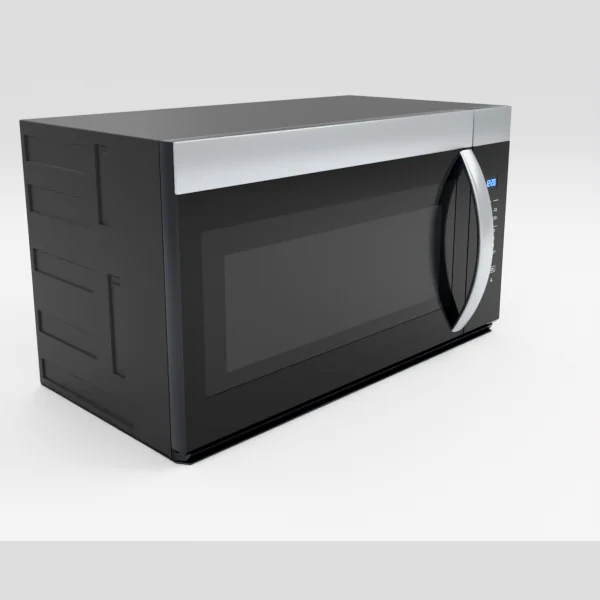
| Over-the-range microwave | A microwave with a small fan and filters underneath | A short cabinet above to bolt into | Shallow and weak as a hood | Tight kitchens and rentals |
| Downdraft | A vent at the cooktop that pulls the air down | Most of the cabinet below; a duct through the floor | Fights a rising plume; poor with tall pots | Islands where nothing may hang overhead |
No prices here on purpose — we do not sell hoods, and appliance prices move with the season. As a rule a recirculating hood is the least expensive to install, a duct across a ceiling can cost more in labour than the hood, and an insert means paying for a hood cabinet too.
Ducted — and why “ducted” is not one thing
Ducted (vented outdoors)
Best wherever there is a realistic route outside
A ducted hood is a fan in a canopy at the start of a pipe to the outdoors. Whatever the canopy catches leaves the building: grease, smoke, smell, the steam from the pasta pot, the heat off the burners and, over gas, the gases the flame makes. It is the only kind of hood that removes moisture and heat at all.
- Removes steam, heat and combustion gases, which no filter can
- Keeps the cabinet tops and the ceiling clean
- Only metal filters to wash; nothing to buy
- Needs a route outdoors, decided before the cabinets
- A poor duct ruins a good hood
- A hole in the house: draughts if the damper fails, and a powerful one may need make-up air
Here is what the slogan leaves out. “Ducted” on a hood box means the hood can be connected to a duct. Whether anything leaves the house depends on the pipe someone fits behind it, which disappears the day the cabinets go up. Five things separate a duct that works from one that only makes noise:
- Smooth, rigid metal. Galvanized steel or aluminium with smooth walls. Ribbed foil dryer hose crushes in a joist bay, holds grease in every rib, and is not what most hood makers’ instructions call for; in many places it is not allowed for a kitchen hood at all
- The size the hood asks for, all the way. The collar on the hood gives the size — commonly 6″ or 8″ round, or the flat 3¼ × 10″ rectangular duct that fits in a stud wall. Never reduce it to suit a hole that was cut too small
- Short and straight. Every foot and every elbow costs airflow. Install sheets usually count each elbow as several feet of straight pipe and give a maximum the fan can push through. The best duct goes straight out through the wall behind the hood
- Outdoors, through a damper and a proper cap. Never into an attic, a soffit, a crawl space or between floors. The soffit is the sneakiest: a vented soffit is where the attic draws its air, so the exhaust gets pulled straight back in
- Sealed, and insulated where it is cold. Seams taped with foil tape; insulation where the duct crosses an unheated attic or outside wall, so winter condensation does not form inside it and run back to the hood
Done like A, a modest hood does honest work for decades. Done like B, the most expensive hood in the showroom is a noisy light. The duct is the hood’s other half, and it is the half nobody photographs.
One of the commonest “ducted” hoods in a tear-out is not ducted at all. It was bought convertible, set to blow out of its top, and screwed under a cabinet with a round hole cut in the cabinet bottom — and nothing above the hole. The air goes into the cabinet, finds its way out round the doors, and the inside of the cabinet goes brown and tacky. The owner hears a fan and assumes the rest.
It is invisible until the hood comes down, and it was decided by whoever drew the cabinets. That is why the duct route belongs on the cabinet drawing, not on the electrician’s list, and why the duct is roughed in before the cabinets go up. In a Canadian winter it is also a hole in the house: a damper at the hood and a flap at the cap that actually close are what keep cold air from falling into the canopy all night.
Ductless — not a smaller version of the same thing
Recirculating (ductless)
Best when there is honestly no route outdoors
A recirculating hood pulls the air up through a metal grease filter, then through a charcoal (activated carbon) filter that takes out some of the smell, and blows it back into the room, usually through slots at the front or top of the hood. It is a filter, not an exhaust. It cleans the air a little and gives it back.
- No duct, no hole in the wall, no route to plan
- Hangs anywhere a hood can hang
- Catches some grease that would otherwise reach the cabinets
- Heat, steam and combustion gases stay in the room
- Charcoal filters to buy and replace every few months
- Smell removal fades as the filter fills, and is never complete
Here is what the brochure blurs. Sort what comes off a pan by what the filters can do about it:
- Grease. Partly. The metal filter catches the larger droplets; the finest mist goes through
- Smell. Partly, and less every week. Charcoal holds odour on its surface until the surface is full, then quietly stops — hence replacing it every three to six months
- Steam and heat. Not at all. The water from the pasta pot comes back into the room and ends up on the windows and the cabinet doors, and the cook gets warmer, not cooler
- Combustion gases. Not at all. A gas burner makes water vapour, carbon dioxide and nitrogen dioxide whether there is food on it or not, and a badly adjusted one makes carbon monoxide. Only exhaust to the outdoors removes them
So when is it the right choice? When it is the only one: a range on an interior wall with no ceiling space for a duct; a condo whose building allows filters only — at least one Toronto corporation’s renovation agreement says exactly that, and the condo page has the detail; a concrete ceiling nobody will let you core; a rental you cannot cut. In those kitchens a recirculating hood is far better than nothing. Make the most of it:
- Buy the widest, deepest canopy that fits. With no duct to carry the air away, capture is all you have
- Put the filters on a calendar. Metal filter washed about monthly, charcoal replaced every three to six months; write the date on the frame when you fit it
- Cook on induction or electric if you can. Then there are no combustion gases to send back into the room — the range comparison covers the rest of that choice
- Handle the moisture another way. Lids on pots, a window open a crack for a long boil, and the bathroom fan or the building’s exhaust running while you cook
Most under-cabinet hoods are sold convertible: ducted out of the box, recirculating with a kit. The kit is the charcoal filter plus, usually, a small part that turns the air out of the front of the hood instead of up. Fit the charcoal without the rest and the hood blows its air up into the cabinet above — which is how a cabinet bottom gets a brown, tacky ring nobody can explain. A recirculating hood should breathe out where you can feel it with your hand.
Under-cabinet, chimney or insert: what each asks of the cabinets
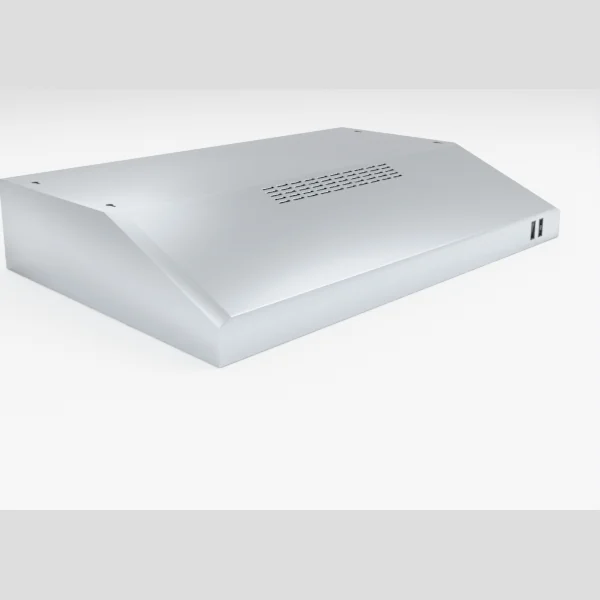
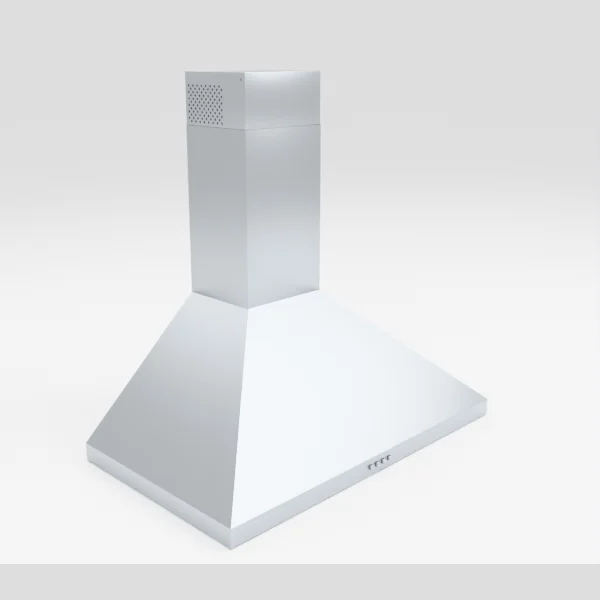
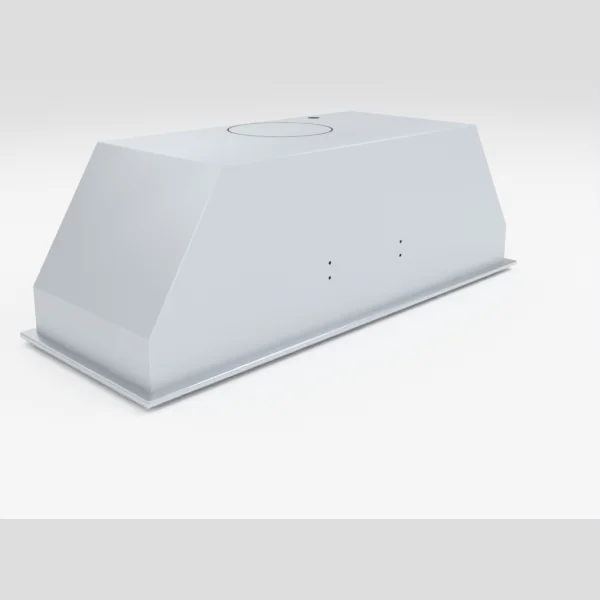
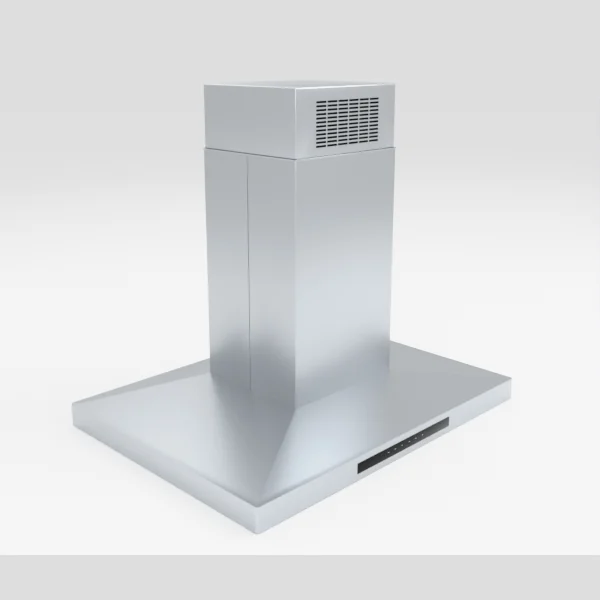
Venting decides what leaves the room. The body decides how big the canopy can be and what the cabinets around the range give up for it. Our own generic renders of the shapes you will meet:
Under-cabinet hood
Best for an ordinary run where the wall cabinets carry on over the range
A slim canopy screwed up into the bottom of a short wall cabinet over the range, usually the width of the range and shorter than its neighbours so the hood lands at the right height. The duct leaves through the top and up through that cabinet, or out of the back straight through the wall.
- The simplest and least expensive body to install
- Keeps the run of wall cabinets unbroken
- Nearly all can be ducted or recirculating
- Many are barely deeper than the cabinet above
- The cabinet above loses storage to the duct
- That cabinet’s bottom lives in the heat and grease
The quiet weakness is depth. Wall cabinets are 12″ deep, and a hood that ends not far past them stops behind the front burners — the ones people use. Check the spec sheet against your burner layout. The second is storage: a duct going up through the cabinet above takes a slice out of the middle of it. Out the back keeps that cabinet whole and is shorter, but needs an outside wall behind the range. Either way it is decided on the cabinet drawing.
Wall chimney hood
Best where the range wall can carry a feature
An open canopy fixed to the wall, with a telescoping chimney cover that hides the duct up to the ceiling. The wall cabinets stop either side of it. Recirculating, it breathes out through slots near the top of the cover.
- Room for a wide, deep, open canopy
- Duct hidden inside the chimney cover
- Easy to clean around; nothing above to grease
- Gives up the wall cabinets over the range
- Needs solid backing in the wall and the right ceiling height
- The cabinet sides beside it face the heat
It asks for a planned gap in the wall cabinets, with finished end panels on the two that now face it; solid backing in the wall, put in before the drywall, because a chimney hood is heavy; and the right ceiling height, since chimney covers come in set lengths. If there is a boxed-in strip above the old cabinets, find out what is inside it first — it may be the old duct.
Insert in a hood cabinet
Best when the hood should look like part of the cabinetry
An insert — also sold as a liner or power pack — is the motor, filters and lights with no body of its own. It sits inside a hood cabinet, a cabinet-built canopy with an open bottom in the same finish as the kitchen, built to the insert’s cut-out size, with the duct leaving through the top.
- The hood disappears into the kitchen
- The canopy can be as wide and deep as the room allows
- Swap the insert later without touching the cabinetry
- Insert plus hood cabinet costs more than a hood
- The insert model must be fixed before the cabinets are made
- A cramped surround makes the filters awkward to reach
Here the cabinet is literally the hood, so the order matters: choose the exact insert first, then build the hood cabinet to its cut-out, not the other way round. And check on the drawing that the filters can drop out of the bottom without the surround crowding them.
Island hoods, over-the-range microwaves and downdrafts
Each of these three solves a layout problem and pays for it in capture. That is not a reason to avoid them; it is a reason to know what you are giving up.
Island hood
Best over an island cooktop, where the ceiling will take it
A canopy hung from the ceiling over an island cooktop, ducted up through the ceiling. With no wall behind it, it works in open air: every opened door and every passer-by bends the smoke sideways.
- The only overhead option for an island cooktop
- A wide open canopy, visible from both sides
- Cross-draughts; wants to be wider than a wall hood
- Heavy; needs blocking and a duct route in the ceiling
- Hard or impossible under a concrete ceiling
Make it wider than the cooktop, roughly 3″ past each side, at the maker’s height. The ceiling decides the rest: the joists run whichever way they run, and the duct has to follow them to an outside wall. The island guide covers the layout side.
Over-the-range microwave
Best where wall space is too tight for both
A microwave with a small fan and grease filters in its underside, hung over the range from a wall plate and bolted up into the cabinet above, so there must be a cabinet above it — usually a short 12–18″ one. Its exhaust is set at install to go out the back, up through that cabinet, or back into the room.
- Two appliances in one space
- Frees the counter of a microwave
- Shallow, with a small fan: a weak hood
- Hangs lower than a hood, closer to the steam
- A hot dish lifted down at eye level over a burner
Makers typically want the top of the unit at least 66″ off the floor, which leaves roughly 13″ between the cooktop and its underside (the appliances page has the detail). It barely reaches the front burners and moves far less air than a dedicated hood. In a rental or a tight galley it earns its place; where someone cooks every night, a real hood with the microwave in a drawer or a tall cabinet is better.
Downdraft
Best for an island where nothing may hang overhead
A vent in the cooktop or rising behind it, pulling the air sideways and down through the cabinet below and out through the floor or toe kick.
- Nothing overhead; clear sightlines
- Disappears when not in use
- Fights a rising plume; poor with tall pots
- Takes most of the cabinet below
- A duct through the floor, hard to change later
Hot air rises; a downdraft asks it to turn round. With a low frying pan near the vent it does a fair job. With a tall stock pot, the steam climbs straight past it. And the drawers you drew under the cooktop may not survive the spec sheet. Reversing a ceiling hood means a ceiling repair; reversing a downdraft means a floor.
What size range hood do I need? Capture first, the box last
Smoke and steam leave a pan as a plume that widens as it rises. A hood works by being where the plume is, holding it a moment, and drawing it away before it spills past the edges. That is capture, and the canopy decides it — width, depth and height — long before the fan comes into it.
- Width. At least as wide as the cooking surface; if the wall allows, about 3″ more on each side captures far more of what comes off the outer burners
- Depth. Deep enough to reach over the front burners, or very nearly. They are the burners in use most of the time, and a front pan’s plume rises in front of a shallow hood, not into it
- Height. 24–30″ above a gas cooktop and 20–24″ above electric or induction, measured from the cooking surface to the bottom of the hood, within the range the maker gives. Too high, and the plume has spread past the edges before it arrives
- Shape. A canopy with a recessed underside holds a sudden burst of smoke while the fan catches up; a thin flat slab lets it roll off the edge
Only then comes airflow. The figure on the box is measured on a test rig with little resistance behind the fan, and your duct will take some of it away. The appliances page has the usual rules of thumb for matching airflow to a cooktop, and they are a fair starting point. But a bigger motor does not fix a canopy that is too narrow, too shallow or too high; it pulls harder at the middle of the hood while the smoke rolls out at the front.
Then there is sound, which decides whether any of this happens. A quiet hood that gets used beats a powerful one that does not. Brochures like to quote the sound rating at the lowest speed, where the hood is barely working. Ask for the rating at the speed you will actually use, and stand under a running one and hold a conversation. And check the hood’s lights as lights: they are often the only task light over the cooktop, so plan the rest of the run in layers.
Powerful hoods, make-up air, and how much hood gas and induction need
Every cubic foot of air a hood pushes out of the house has to be replaced. In an old, leaky house it seeps back in round the windows and doors. In a tight house — new, or old with new windows and sprayed insulation — a powerful hood can pull air backward down whatever chimney it finds: a furnace flue, a water heater’s vent, a fireplace. That is backdrafting, and it draws combustion gases into the house. A milder sign of the same thing: a door that whistles or is hard to open when the fan is on high.
That is why, above a certain airflow, your local code may require make-up air: a dampered supply that opens when the hood runs and lets outside air in. The threshold varies from place to place, and it matters most in a tight house with fuel-burning appliances. Ask your building department, or whoever services your furnace, before you buy a big hood. Furnaces and water heaters that take their air from outdoors through their own pipe are far less exposed than older ones that draw from the room. A carbon monoxide alarm is not optional either way. And if the hood will be ducted through an outside wall, check whether your municipality wants a permit.
The cooktop under the hood changes how much hood you need:
- Gas. A flame makes heat, water vapour and combustion gases even with nothing on it, so the plume is hotter, bigger and wetter. The hood hangs higher, so it needs to be wider and stronger to catch the same plume, and venting outdoors matters most here
- Induction. Heat goes into the pan and there is no flame, so what is left is cooking itself: grease, smoke and steam. The hood can hang lower, which helps capture, and a more modest one will usually do. Radiant electric sits between the two
- The cook matters more than the fuel. Searing, stir-frying and deep-frying make far more grease and smoke than simmering. A wok kitchen on induction needs more hood than a soup kitchen on gas
Induction does not remove the need for a hood. It removes the part of the problem a recirculating hood was worst at, which is why induction and a recirculating hood are the sensible pair in a condo that forbids venting. Gas, induction and electric have their own page.
How a hood really fails: a week, a year, ten years
A hood rarely breaks. It fades, and the kitchen records the fading.
The first week. The only test most people do is to hold a tissue under the hood and watch it stick to the filter. That proves suction at the filter, not capture at the front burners. The real test is bacon on the front burner, and whether the smell reaches the next room.
The first month. Habits set. If the fan is loud, it goes on late and off early, and from here on the hood is mostly a light. On a bad duct it is loud for a reason: a fan pushing against a long, crushed or undersized pipe roars more and moves less.
The first year. The filters fill. An unwashed metal filter goes from mesh to felt; a charcoal filter passes its useful life somewhere between three and six months, and smells start to linger. Inside the duct, grease begins to coat the walls — thinly on smooth metal, thickly in every rib of a flexible hose.
Five years. The damper at the hood gums up and sticks half open, and so does the flap outside; on a windy winter day the hood whistles with the fan off.
Ten years. The tops of the wall cabinets are amber and tacky under a thumb, with a grey fur of dust stuck in the film. The ceiling above the range has yellowed in a rough oval. If the duct ended in the attic, the insulation around its mouth is dark and matted and the wood above may be stained or mouldy. If it went outside, its inside carries a layer of grease that is now a fire load behind the cabinets. All of it was visible for years to anyone who stood on a chair.
Notice what did not change with time: a hood that was too narrow, too shallow or hung too high was exactly as bad on day one. Those are design faults, not wear, and no amount of maintenance fixes a canopy in the wrong place. The backsplash behind the range takes whatever the hood misses, which is one reason a glazed tile or stone backsplash that wipes clean earns its place there.
What an installer does that the brochure never mentions
Most of a hood’s performance is settled in the hour before it is screwed to anything. Good installers have the same handful of habits, and they matter more than the step up to the next model.
Plans the duct route before the cabinets are ordered. It passes through the cabinet above or the wall behind, and takes storage or framing either way; decided late, it is decided by a hole saw. Uses rigid metal, tapes the seams, takes the shortest route. Smooth pipe at the collar’s size, every joint sealed with foil tape rather than cloth duct tape, which dries out and lets go. Goes outside and watches the cap. Fan on, the flap swings open; fan off, it falls shut. A minute’s check that catches the cap painted shut on day one.
Mounts at the height the maker gives, within the site’s range — inside 24–30″ over gas or 20–24″ over electric and induction — then checks it against the tallest cook’s forehead. Leaves access to the filters, so they drop out with one hand and nothing in the way, and a way in to the damper and fan. Puts blocking in before the drywall for a chimney or island hood. In a condo, reads the building’s rules on venting first — before the hood is bought, not after it is hung.
The hood also needs power, usually hidden in the cabinet above or behind the chimney cover. Adding or moving it is electrical work, which in most of Canada means a licensed electrician or a permit.
Five things a hood does not decide
A lot of hood shopping is spent on numbers and features that do not change what ends up on top of the cabinets.
- How much air it really moves. The rated airflow is a test-rig number. In your kitchen the duct decides: a short, smooth, full-size run keeps most of it; a long, crushed or reduced one throws much of it away.
- How loud it really is. Partly the motor, but the duct again. A fan pushing against a small or twisted duct works harder and sounds worse at every speed.
- Whether the windows fog in winter. Cooking is one source of indoor moisture among many. The house’s own ventilation decides winter humidity; a hood helps only while it runs.
- Whether smoke escapes from the front burner. People buy a bigger motor to fix this. It is depth and mounting height: a deeper canopy, or the same hood hung lower within the maker’s range, fixes it.
- How well it captures, from its finish. Stainless gauge, glass panels, touch controls and apps change the look and the price, not the capture.
And one piece of language to watch for: “professional-style.” A restaurant hood works because it hangs over the whole cooking line with a huge canopy, a duct built for it and make-up air by design. At home the name usually means a heavy body and a big motor. Without the duct and the make-up air to match, the big motor is mostly noise.
How to tell what you are being sold
In a showroom, switch the hood on, stand where you would cook, and talk over each speed. Look underneath: mesh filters, or baffle filters (overlapping metal channels that make grease turn corners), and whether they come out with one hand. Hold your palm under the front edge and feel how far forward the pull reaches. Then ask for the install manual before the price; the questions that matter are answered there:
- What size duct does it need, and how many feet and elbows can it push through? — if your route is longer, you need a different hood or a different route
- What is the sound rating at the speed I will actually use? — not the lowest one in the brochure
- How deep is the canopy, and does it reach my front burners? — take your cooktop’s burner layout with you
- What height range does the maker allow over my kind of cooktop? — and does it suit the tallest person who cooks
- What does the recirculation kit include, and where will I buy filters in five years? — a charcoal filter that is hard to find never gets changed
- Is there a damper at the hood, and is a wall or roof cap included? — often it is not
We do not sell range hoods or any other appliance, which is why this page can be neutral about them. What we build are the cabinets around the hood: the short wall cabinet an under-cabinet hood or an over-the-range microwave hangs from, the hood cabinet an insert sits inside, and the finished end panels beside a chimney hood. That makes the duct route a cabinet decision — up through the cabinet above or out the back, and whether that cabinet loses a shelf to it — and it is far easier to settle on the drawing than with a hole saw.
In the free planner you can drop a hood over the range, see how it sits against the wall cabinets in 3D, and get the cabinets around it quoted. Buy the hood wherever you like; the appliance chapter and its question list cover the fit.
What we would do, kitchen by kitchen
General rules are easy. Here is how the choice actually falls for the kitchens people really have.
A family house you plan to stay in, with the range on an outside wall. Ducted, straight out through the wall behind the hood. Under-cabinet or chimney as the design wants, but at least as wide as the cooktop and deep enough for the front burners. Spend the difference between two motors on a quieter hood, not a stronger one.
A house with the range on an interior wall. Usually still ducted: up through the cabinet above and along the ceiling to an outside wall, if the joists run the right way and the route stays short. If it turns into a long run with four elbows, move the range to an outside wall while the kitchen is open, or accept a recirculating hood and cook on induction. A long, twisting duct gives you the cost of ducting and the performance of a filter.
A condo. Read the building’s rules before anything else. Many allow filters only. If it is recirculating, buy the biggest canopy that fits, cook on induction, and put the filters on a calendar. That combination is honest and livable.
Someone who cooks hard every day — searing, stir-frying, deep-frying. Ducted, and generous: a wide, deep canopy, an insert or a chimney hood with baffle filters, quiet at middle speed. On gas, raise the make-up air question at the start; this is the kitchen most likely to need it.
A cooktop in an island. Think twice. Under a cooperative ceiling, an island hood wider than the cooktop works; a downdraft suits someone who cooks low and gently. If neither fits, put the cooktop on the wall under a proper hood and give the island the sink.
A rental, or a house you are fixing to sell. Ducted under-cabinet if a real duct already exists — check it, all the way to a cap. An over-the-range microwave is acceptable where space is tight.
A small kitchen. The over-the-range microwave is tempting because it saves space. An under-cabinet hood plus a microwave in a drawer or a tall cabinet does the hood’s job properly. If you cook more than you reheat, take the hood.
- There is an outside wall behind the range. Ducted, straight out the back, shortest possible run.
- The building forbids venting. Recirculating, biggest canopy, induction if you can, filters on a calendar.
- You cook hard every day. Ducted, deep canopy, quiet at middle speed; ask about make-up air early.
- You want the hood to disappear. An insert in a hood cabinet, with the insert chosen first.
- The cooktop is in an island. A ceiling hood if the joists allow; otherwise rethink where the cooktop goes.
- The kitchen is tight. An under-cabinet hood and a microwave elsewhere beat an over-the-range microwave.
If you already have a hood
Most kitchens already have the hood they will live with for years. An hour on a Saturday tells you what it is really doing.
- Take the filters down. Wash the metal ones — the appliance care page has the routine — and replace any that has gone solid. A charcoal filter behind them means the hood recirculates; replace it if it is older than about six months.
- Go outside with the fan on high. Watch the flap on the cap open, then close when you switch off. If nothing moves, or there is no cap, the hood has been recirculating whether you knew it or not.
- Look at the duct where you can reach it. In the cabinet above the hood, or from the attic hatch. Foil hose, a duct that stops in the cabinet or one that ends in the attic is a job for a professional, and worth doing.
- Test the front burner. Boil water on a front burner with the fan at middle speed and watch the steam. Into the hood is good. Rolling out past the front edge is a canopy problem — too shallow or too high.
- Clean the tops of the wall cabinets once, escalating slowly if they are sticky, and check them again in a month. That is your free, honest hood test, repeated forever.
- Change the habit. Fan on before the pan goes on, off ten to fifteen minutes after you finish. The cheapest upgrade a hood will ever get.
The rest of the cooking wall has its own decisions: gas, induction or electric underneath, quartz or granite or porcelain for the counter beside it, and MDF or solid wood for the doors that take the steam.
Straight answers
Is a ducted range hood better than a ductless one?+
Yes, wherever you can run a duct. A ducted hood carries grease, smoke, steam, heat and, over gas, combustion gases out of the house. A ductless or recirculating hood traps some grease and some smell in its filters and returns everything else to the room, including all the moisture. Choose ductless only when there is genuinely no route outdoors, such as an interior wall in a condo that forbids venting.
Do recirculating range hoods work?+
Partly. The metal filter catches some grease and the charcoal filter removes some cooking smell, as long as the charcoal is replaced every three to six months. A recirculating hood does nothing about steam, heat or the gases a gas burner makes; those go straight back into the room. It is a reasonable answer where venting is impossible, and a poor substitute where it is not.
What size range hood do I need?+
At least as wide as the cooking surface, and wider if the wall allows: about 3″ past each side captures far more. Deep enough to reach over the front burners, and mounted 24–30″ above gas or 20–24″ above electric or induction, measured from the cooking surface to the bottom of the hood. Capture area matters more than the airflow number on the box.
Is an under-cabinet or a chimney range hood better?+
Neither captures better because of its type; the width and depth of the canopy decide that. An under-cabinet hood keeps the run of wall cabinets unbroken and is the simpler install, but many models are shallow. A chimney hood needs a gap in the wall cabinets and backing in the wall, and usually offers a deeper, more open canopy. Choose by layout, then compare depth and width.
Can a range hood vent into the attic?+
No. A kitchen hood must end outdoors, through a wall cap or roof cap with a damper. Exhaust dumped into an attic, a soffit or a crawl space carries grease and moisture into the insulation and framing, where it feeds mould and leaves a greasy fire load. A soffit is no better than the attic itself, because a vented soffit is where the attic draws its air.
How high should a range hood be above the stove?+
24–30″ above a gas cooktop and 20–24″ above electric or induction, measured from the cooking surface to the bottom of the hood. Lower is a heat and head-clearance problem; much higher and the plume spreads past the edges before the hood can catch it. Where the hood maker’s instructions give a different range, follow the instructions for that model.
Do I need make-up air for my range hood?+
Possibly. Every cubic foot a hood pushes out has to be replaced, and in a tight house a powerful hood can pull air backward down a furnace, water-heater or fireplace flue. Above a certain airflow, set by your local code, a make-up air system may be required, especially where fuel-burning appliances share the house. Ask your building department before you buy, not after.
Does an induction cooktop need a range hood?+
Yes. Induction removes the flame, and with it the combustion gases and much of the waste heat, but frying, searing and boiling still put grease, smoke and steam into the air. An induction kitchen can usually get by with a more modest hood than a gas one, and the hood can hang lower, 20–24″ above the cooktop, which helps it capture.
Is an over-the-range microwave as good as a range hood?+
No. It is a microwave with a small fan and filters underneath, shallow enough that it barely covers the front burners, and it usually moves less air than a dedicated hood. It is a reasonable compromise in a tight kitchen or a rental. If you cook most nights, a real hood with the microwave in a drawer or a tall cabinet is the better arrangement.
How often should range hood filters be cleaned or replaced?+
Wash metal mesh or baffle filters about once a month, or every two weeks if you fry or wok-cook often. Charcoal filters in a recirculating hood cannot be washed and are replaced every three to six months; when cooking smells start to linger, they are spent. A filter that has gone solid with grease turns any hood into a noisy light.
Plan the duct before the cabinets.
Drop a hood over the range in the free planner, see how it sits against the wall cabinets in 3D, and decide where the duct goes while it is still a line on a drawing.
Open the 3D planner →