Porcelain Slab vs Quartz, Honestly Compared
We sell quartz and we do not sell porcelain slab, so hold us to saying where porcelain wins — it wins in more places than a quartz seller usually admits. Here is how each surface ages over ten years of cooking, where the damage lands, which marks can be fixed, and the kitchens where each one is the right call.
Walk through a fabricator’s shop that cuts both, and the difference is in the air. On one A-frame leans a porcelain slab as big as a door and barely thicker than a floor tile. When it has to move, two people carry it on edge with suction cups clamped to the face, and nobody talks and nobody breathes until it is lying flat on the table. On the next A-frame stands a quartz slab three times as thick, and the same two people handle it like what it is: heavy, solid, a little dull to watch. Those two slabs are about to swap personalities. Once it is glued down on level cabinets, the porcelain becomes close to indestructible — heat, sun and stains go straight past it. The quartz, which got through the shop without anyone worrying, spends the rest of its life one hot pan away from a permanent mark. Almost everything worth knowing about this choice follows from that swap.
Porcelain slab — also sold as sintered stone or an ultra-compact surface — wins on the face: a hot pan, strong sun, wine and a knife leave it unmarked, and its thin, very large sheets suit long islands, outdoor kitchens and a matching backsplash. It loses at the edges: corners and cutouts can chip, a chip on a printed slab shows a different colour, and it needs a fabricator who does it often. Quartz is the reverse: a solid, forgiving body that is easy to fabricate and repair, but its resin can scorch under a hot pan and does not belong in the sun.
Read a ten-year-old counter before you choose a new one
If you can, find one of each that has been cooked on for years — a friend’s kitchen, the house you are leaving. Bend down until your eye is level with the surface, look along it toward the window, then run a fingertip around every edge. (A note on names: porcelain slab, sintered stone and ultra-compact surface are trade names for closely related products, and this page calls all of them porcelain slab.) Anyone who repairs countertops will tell you the marks gather in the same few places every time — and on these two materials they are not the same places.
- The corner by the dishwasher. Run your thumb along the front edge of a porcelain counter above the dishwasher, where a heavy pot swings on its way to the sink and the dishwasher door or a stool catches the edge. If anything has happened, it is a small, clean, shell-shaped scallop missing from the edge — and on most porcelain counters it is a different colour from the face: a pale, plain body under a printed marble or concrete look. From across the room it reads as a white fleck on a dark counter. What it tells youPorcelain does not wear; it gets knocked. Nearly every story it has to tell is written along an edge.
- The front lip of the sink cutout. On an undermount sink the cut edge of the hole is on show all the way round, and its front lip is where pans and the rim of a cast-iron pot land. Look for small chips along that lip, with the same change of colour. On a printed slab you may see the body even where nothing has chipped, as a narrow band just inside the rim. What it tells youEvery cut through porcelain exposes what lies under the pattern, and a sink cutout is a long cut where hard things land.
- A hairline from the cooktop corner. Lift the grates and look at the four inside corners of the cooktop cutout. If a porcelain counter has cracked, this is the likeliest place: a fine, nearly straight hairline that starts at an inside corner and runs across the narrow strip to the nearest edge. Hold a flashlight flat to the surface; you will often feel it under a fingernail before you see it. What it tells youAn inside corner concentrates stress, and a thin strip has little in reserve. Most of these cracks were decided on cutting day and by the cabinets underneath, not by the slab.
- The glue line of a mitred edge. On the island, a thin porcelain top has been folded down to look thick: two pieces meet at a 45° mitre on the very corner of the edge. On good work the line is a hair and the pattern wraps round it. On a poor one, after years, the filler has darkened a shade, or the line has opened enough to catch a fingernail, or a short sliver has broken away along it. Tap the edge with a knuckle and it sounds hollow, because it is. What it tells youThe thick-looking edge is a fold, not a block. How it ages depends on the glue and on whoever cut the mitre.
- Beside the cooktop, and at the sunny end. Now the quartz counter. Most of it looks almost new. Beside the burners, on the side the pans come off, look for a pale or faintly yellowed patch, sometimes a crisp ring the size of a pan base. Then lift the fruit bowl that has stood for years at the end under the window: on some colours the counter around it has gone a shade warmer than the patch it covered. What it tells youQuartz is marked by heat and by light. Both reach its resin binder; neither has anything to work on in porcelain.
- A chip and a seam. Quartz gets chipped too — a corner by the sink, a nick on the island edge where the stools live. But the chip is the same colour all the way into the stone, and if someone has filled it you may have to hunt for it. Then find the seam: a long quartz island is usually two pieces, and after ten years the filler may have darkened slightly, or one side sits a hair above the other. What it tells youQuartz is the same material all the way through, so its accidents stay small. Its seams are glue, like the porcelain mitre, and they age like glue.
Now notice what you did not find. On the porcelain counter, nothing at all on the face: no scorch by the cooktop, no fade under the window, no stain under the oil bottle, no dull track where pots have been slid for ten years. It looks exactly as it did the day it went in. The quartz face is mostly fine too, apart from a few single, permanent marks where heat and sun reached it. That is the whole comparison in one line: porcelain keeps its face and spends its edges; quartz keeps its edges and spends its face. Everything below is detail on those two halves.
What they search at midnight “porcelain vs quartz countertops” — decide where you are hard on a counter: on the surface with heat, or on the edges with pots.
Porcelain slab and quartz, side by side
| Porcelain slab | Engineered quartz | |
|---|---|---|
| What it is | Clay and mineral powders pressed and fired into a dense sheet; no resin | Ground quartz bound with resin and pigment |
| Usual thickness | About 12 mm for counters; 6 mm and 20 mm too | 2 cm or 3 cm |
| Hot pan | Unharmed | Can scorch, permanently |
| Sun and outdoors | Colour-stable; used outdoors | Resin can yellow or fade; indoors only |
| Stains and sealing | Resists stains; never sealed | Resists stains; never sealed |
| Knives and grit | Very hard to scratch | Very scratch resistant |
| Edges and cutout corners | The weak point; can chip or crack | Forgiving; chips stay small |
| A chip shows | On a printed slab, a paler or plainer body | More of the same stone |
| Repair | A chip is hard to hide; a crack usually means a new piece | Chips fill and polish well; a scorch does not come out |
| Thick-looking edge | A mitred fold of two thin pieces | Solid at 3 cm, or a built-up strip on 2 cm |
| Fabricators | Fewer; special tools and careful handling | Many; routine work |
| Weight | Light for its size | Far heavier at 3 cm |
No prices here on purpose. As a finished counter, porcelain slab often costs more than a comparable quartz, and most of the difference is in the fabrication rather than the slab — but the spread inside each material is wide, and a premium quartz can land above an ordinary porcelain. Have two shops quote the same drawing in both.
Porcelain slab — and why it is not one product
Porcelain slab
Best where heat, sun or sheer size would beat any other surface
Porcelain slab is made the way porcelain tile is made, only enormous: fine clay, feldspar and other mineral powders pressed hard and fired far hotter than anything a kitchen can produce. There is no resin in it to scorch or yellow, and it is so dense it absorbs almost nothing, so the face ignores heat, sun, stains and nearly all scratches. The tile guide explains why porcelain is denser than ceramic; the same holds at slab size.
The price of that hardness is brittleness: a thin, very hard sheet does not dent or bend; it chips or cracks. And the usual countertop sheet is about 12 mm, less than half a typical quartz top, so everything that looks thick about a porcelain counter has been built.
- Hot pans straight on it, with no mark
- Sun and outdoors, without fading
- Very large, light sheets — long islands and a matching backsplash
- Edges and cutout corners chip; a chip is hard to hide
- Fewer fabricators; mitres and cutouts need experience
- Pattern is often printed on the face, not through the body
Here is what the name leaves out. Makers argue about recipes, presses and kilns, and the differences between their sheets are real, but they are small next to four plainer facts about the slab in front of you:
- Thickness. Roughly 6 mm, 12 mm and 20 mm are the common ones. The 6 mm sheet is made for walls, backsplashes and cladding, and goes onto a counter only when bonded to a full backing board. The 12 mm sheet is the usual countertop. The 20 mm sheet is stiffer and heavier, often chosen for outdoor kitchens, and not made in every colour. Ask which one the quote is for — the showroom sample may be a different thickness
- Printed face, or colour through the body. Most marble, stone and concrete looks are printed: a decorated layer on the face of a plainer body, often light grey, beige or off-white. Some lines tint the body to match, and a few carry the colour — sometimes the veins — down through the thickness. A plain colour on a matching body is the most forgiving porcelain there is; a dark marble look printed over a pale body is the least
- Finish. Polished, matte, or a satin in between. Polished shows the pattern at its deepest, and fingerprints and water spots too. Matte hides those, but pots and utensils can leave grey streaks on it — metal rubbed onto the surface, not scratches in it — which a mild cream cleaner takes off
- The edge it can take. Because the pattern may not run through, porcelain is usually finished with a lightly eased edge, a crisp exposed thin edge or a mitred fold. Rounded and ogee profiles would grind through the face into the body. If you want a profiled edge, you want quartz or natural stone
The slab is most at risk before it ever reaches your house. A porcelain sheet comes out of the kiln with some tension locked inside it, and shops that cut a lot of it have rituals for letting that out gently: the sheet lies fully supported on the table, many shops trim the ends before the cuts that matter, the saw runs slower than it would through quartz, and finished pieces travel on edge. A slab broken in the shop means the job waits for another one — from the same lot if you are lucky. That risk sits in every porcelain quote, whether or not anything breaks.
The other thing fabricators know: the body decides everything. Two counters with the same face are different products if one has a matching body and the other a plain one. Ask for a broken offcut of the line, not a polished one, and look at the break in daylight. That is what every future chip will look like.
What twelve millimetres means on top of your cabinets
A 12 mm top is about half an inch, and it weighs far less than people expect, which is good news for the boxes underneath. What thinness changes is how the edge is made, how the top is held up, and where it can crack.
The edge first. Most porcelain counters that look thick are mitred: a strip cut from the same sheet, its top edge and the counter’s front edge both bevelled to 45° and glued, so the pattern wraps round the corner. Done well, it is the most convincing thick edge any material can produce, because the veins really do turn the corner. But it is a fold, not a block. Behind the strip there is air, or a support strip, until you reach the cabinet, so a knock on the bottom of a mitre lands on 12 mm of porcelain with nothing behind it.
The alternative is to leave the edge thin and show it. A crisp half-inch edge looks clean and modern on a slab whose body matches its face. On a printed slab the exposed edge is a stripe of body colour — a pale line under a dark counter — which some people like and some find unfinished. Look at a real one before you decide.
Support is the second thing. A thick quartz top bridges small gaps by itself. A thin porcelain sheet wants to lie on something flat and continuous: some fabricators lay a sub-top or a grid of strips over the cabinets first, others rely on the cabinet tops, and each maker publishes its own rules for overhangs. Do not take a porcelain overhang number from the internet, including from us. Ask the fabricator, in writing, what will go under the slab and under every overhang, and plan support for an island’s seating overhang from the start — the island guide covers sizing it.
Then the cutouts. A sink hole and a cooktop hole leave narrow strips in front and behind, and every inside corner of a hole is where stress collects. A square corner in porcelain is an invitation to the hairline in item 3 above, so good shops cut those corners round, support the strips, and leave a little room around a cooktop. Porcelain takes undermount and drop-in sinks alike, but an undermount shows the cut edge of the hole; the sink guide covers the choice itself.
Last, the cabinets underneath. Porcelain forgives an out-of-level run least of all: a thick quartz top bridges a small dip and sits; a thin sheet pressed into the same dip is under stress for the rest of its life. Fix the run before template day — here is how to get cabinets level for a countertop.
Quartz — the forgiving one
Engineered quartz
Best where edges take knocks and you want any good shop to be able to make and mend it
Quartz is made, not quarried: crushed natural quartz mixed with resin and pigment, pressed and cured into slabs, usually 2 cm or 3 cm thick. The resin fills every gap, so the slab is non-porous, resists stains and never needs sealing. Because the colour is mixed into the whole slab, a cut, an edge or a chip shows the same material as the face.
Its weakness lives in the binder. A pan straight off the burner, or a slow cooker running for hours on one spot, can scorch the resin — a pale or yellowed mark that cannot be polished out — and strong sunlight can yellow or fade it, which is why quartz stays indoors. The quartz care guide keeps coming back to those two things.
- Solid body — chips are small and match
- Forgiving edges; almost any profile can be cut
- Many fabricators; straightforward to repair
- Hot pans can scorch it, permanently
- Not UV-stable — indoors only
- Heavy; long islands usually need a seam
Quartz is not one product either; the differences just hide in other places:
- Thickness, and built-up edges. A 3 cm top is stiffer over an overhang. A 2 cm top can be given a heavier look with a strip laminated under the front — the quartz version of the porcelain mitre, with the same glue line to watch
- Veins through the body, or mainly on the face. Some marble-look quartz carries its veining mainly near the top, so a cut edge shows a plainer body with streaks. A chip there is still far less visible than on printed porcelain; marble vs quartz goes into this
- Batch and resin. Quartz is consistent within a production run, close between runs, and recipes differ in the resin that heat and sun attack. Cut the whole job from one batch, keep a labelled offcut, and read the care rules for the slab you actually buy

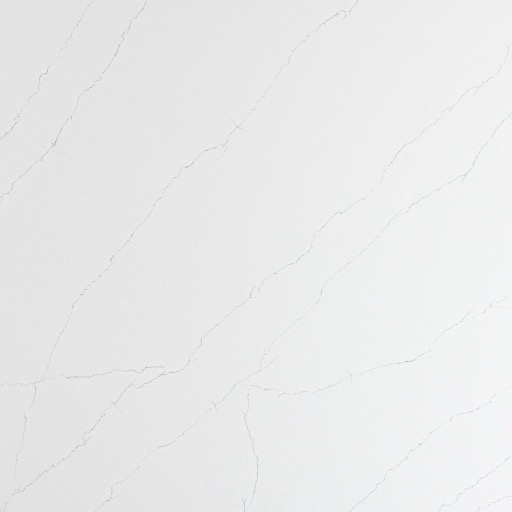
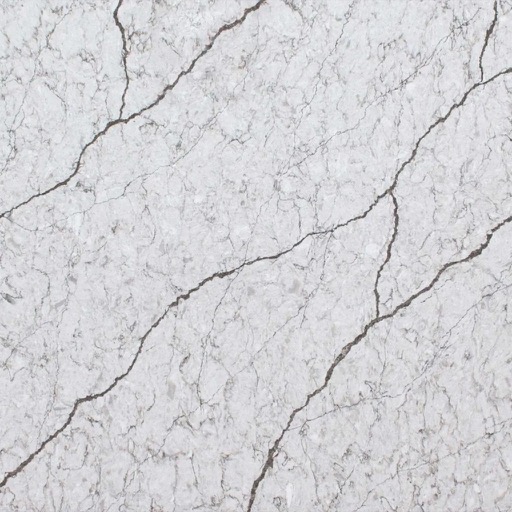
Three of our own quartz slabs. In a plain colour the body is the face, all the way down; veined designs carry their pattern into the body as streaks that do not always line up with the face. Either way, a chip shows quartz, not a different material.
Ask a fabricator which material they would rather install on a Friday afternoon and you will hear quartz. It comes off the A-frame without ceremony, cuts on standard stone tools, shrugs off a small bump in handling, and when a corner gets nicked in the shop they fill it, polish it and nobody ever knows. That ordinariness is worth more to you than it sounds: more shops can do the job well, quotes are easier to compare, and almost anyone can repair it later.
One warning that belongs to the shop, for both: cutting engineered quartz throws off fine crystalline silica dust, a well-known lung hazard, and cutting porcelain makes silica dust too. Good shops cut wet, with extraction. A finished counter gives off nothing. Do not cut or grind either one yourself, dry.
Where porcelain clearly wins — and where quartz does
We sell quartz, so start with the plain version of where porcelain beats it.
- Hot pans. A pan straight off the burner, a roasting tray out of the oven, a pot set down while you look for a trivet: porcelain does not care, because there is no resin in it and it was fired far hotter than any oven. On quartz each of those is a gamble with a permanent mark. For a cook who sets things down without looking, this one point can decide it
- Sun, and the outdoors. A counter under a big south-facing window, a sunroom, an outdoor kitchen: porcelain keeps its colour in ultraviolet light and absorbs so little water that frost usually leaves it alone. Quartz is an indoor material, full stop
- Very long islands. Porcelain sheets come large, and because a thin sheet weighs a fraction of a thick slab, a long piece can actually be carried into a house. The gap against the biggest quartz slabs is smaller than brochures suggest, so check the sheet size against your island before planning on no seam
- The same material up the wall. Thin sheets were made for walls. A 6 mm sheet from the same line can run from the counter to the underside of the wall cabinets with very few joints, so counter and wall read as one surface. A full-height quartz backsplash is possible, but heavier and thicker at every edge
And here is where quartz clearly wins:
- A solid body. A knock on the edge leaves a small chip of the same stone, not a fleck of another colour
- Forgiving edges. Three centimetres of solid material at the front, cut into whatever profile you like, with no mitre and no hollow behind it
- More fabricators. Nearly every countertop shop cuts quartz every day. Shops that do porcelain well are fewer, and in some towns the nearest is a drive
- Easier repairs. A chip fills with tinted resin and polishes back nearly invisible, and a crack can often be glued
- Predictable. Fewer things can go wrong in the shop and on installation day
So the two are not ranked; they are mirror images. Porcelain is tougher where you use a counter; quartz is tougher where you hit it. Which one you need depends on how you cook, where the counter sits, and how much you trust the shop that will make it.
How each one fails: a week, a year, ten years
The brochures show both surfaces on installation day. Here is the rest of the film, for a kitchen that cooks most nights.
Porcelain, installation day. The most dangerous day of its life. It is carried in on edge and lowered onto the cabinets, and a twist on the way in, or a high spot on the cabinets, is when a crack begins. Much of the risk is spent before anyone cooks on it. The first week. Usually nothing; on a matte finish, perhaps the first grey streak where a pot was slid. The first year. The face is untouched. If there is going to be an accident, it often comes now, while the household is still learning the edges: a cast-iron pan clipped on the sink cutout, a stool swung into an island corner. Ten years. The face looks as it did on day one, and that is the whole case for porcelain. The edges carry the record.
Quartz, installation day. Routine. The first year. Usually nothing; at most a dull film where a cleaner that does not suit the resin was used. Ten years. Most of the surface is as it was, except where single events marked it: a scorch beside the cooktop, a cloudy patch where the slow cooker lived, a warmer tone at the sunny end. Its marks are on the face. Its edges look fine.
What a chip feels like. A porcelain chip is usually crisp and sharp-rimmed, like a chip out of a good dinner plate. A quartz chip feels rougher and more granular, more like broken stone. Either way, keep the flake if you find it: a clean one can sometimes be glued back so well that only you know where it was.
Repairs are where the two part company most. On quartz a repairer fills a chip with resin tinted to the stone and polishes it, and on most colours it all but disappears, because the stone around it is the same all the way down. On porcelain the same repair fixes the shape but not always the colour. A plain slab with a matching body takes a fill well; on a printed marble look the fill is one colour in a field of veins, and you can always find it. Nor can a printed face be ground and re-polished, because grinding takes the pattern with it. A crack across a porcelain top usually means a new piece; a crack in quartz can often be glued and filled, visibly but soundly.
Who cuts it matters more than which slab you choose
With quartz, the slab matters and so does the shop. With porcelain, the shop is most of the result. Fewer fabricators do it, and the ones who do need different tools and habits: blades made for porcelain and slower cuts, water-jet or CNC machines for many cutouts, more hands in handling, and the patience to glue a mitre that has to look like one piece of stone. The risk of breaking a sheet is carried in the labour on every quote. None of that is a reason to avoid porcelain. It is a reason to choose the shop before you choose the slab.
Whichever slab you fall for, these six habits matter more than the name on it:
They can tell you how many porcelain jobs they do a month. Not whether they can — whether they do, routinely. A shop that does one a season is learning on your kitchen. Ask to see a finished mitre and a sink cutout on their own work. They radius every inside corner of a cutout. Rounded inside corners on sink and cooktop holes, never square ones, and support under the narrow strips. They put full support under the slab. A good shop tells you what goes under the slab and under every overhang, and writes it on the quote. They glue and colour-match the mitres. Adhesive tinted to the face, and a joint tight enough that the pattern wraps without a stripe. They template only after the cabinets are level. Not from drawings and not from the old counter; a few millimetres a thick top would bridge becomes a stress point under a thin one. They handle and store it on edge. On an A-frame, with suction cups; a long piece carried flat between two people is a piece about to crack.
A good quartz shop does most of this without being asked. If you want to start the first conversation with a drawing rather than a sketch, the countertop drawing tool gives every piece, seam and cutout with its area. That drawing is for the quote; the template the slab is cut to still comes after the cabinets are in.
Six things this choice does not decide
A lot of the heat in this argument comes from blaming the slab for things it has nothing to do with.
- Whether the cabinets can carry it. Standard base cabinets carry either. A 12 mm porcelain top is much the lighter; a 3 cm quartz top is heavy but well within what a properly joined, level run is built for. The boxes care about level, fastening and support.
- How clean the kitchen is. Both are non-porous, neither needs sealing, and both wipe clean with warm water and a mild cleaner. Neither is where germs live. The cutting board is.
- How it photographs. From standing distance, a good porcelain marble look and a good quartz marble look are hard to tell apart. The differences are up close, at the edges and over years.
- Whether a knife scratches it. Neither scratches easily; both blunt the knife. Use a board on either, for the knife’s sake.
- What the house is worth. Buyers notice condition, colour and layout long before they ask what a counter is made of. A chipped top of any material costs more at sale than the choice between these two.
- The backsplash. Tile goes above either one — porcelain or ceramic, your choice. Porcelain slab makes a matching full-height backsplash easier; it does not make one necessary.
And one piece of sales language to watch for: “indestructible.” The face of a porcelain slab is close to it. The edge is not, and the word tends to be used by somebody standing beside a sample with no cutouts in it. Its twin is the claim that sintered stone is a wholly different and stronger material than porcelain slab. They are close relatives; compare the thickness, the body and the shop, not the name.
How to tell what you are being sold
A showroom sample is small, finished on every edge and lit from above — the most flattering way to see anything. For porcelain, look at exactly what the sample hides: the body. Turn it over and look at the back, then ask for a broken offcut of the same line and look at the break in daylight. Ask to see a mitred corner and a sink cutout on a finished job. For quartz, ask to see your edge profile on a real cut piece.
The names tell you little. These questions tell you more:
- What thickness is the slab on this quote? — 6, 12 or 20 mm for porcelain, 2 or 3 cm for quartz; the sample may not be the same
- Is the pattern printed on the face, or does the colour run through the body? — for porcelain, the single most important answer on this list
- How many porcelain jobs does your shop do in a month? — and can I see a recent one
- Mitred edge or exposed edge — and what is behind the mitre? — air, a support strip, or something else
- What goes under the slab and under each overhang? — written on the quote, not said at the counter
- How big is the sheet, and where will the seams fall? — against your actual island length, not the showroom’s
- How would you repair a chip, and can I keep an offcut? — the honest answer differs for a printed face and a matching body
- Can the backsplash come from the same lot? — if you want the counter and the wall to read as one
Every countertop we supply is engineered quartz — the Clean, Essence and Signature series, plus the longer list behind More colors. We do not sell porcelain slab; if you choose it, it comes from a local fabricator. Where porcelain beats what we sell — hot pans, sun, outdoor kitchens, a very long island, a whole wall in one material — we have said so, and we mean it.
Either way, the free planner draws the top for you: the countertop over your cabinets with its sink and cooktop cutouts, seams and waterfall ends, a stone backsplash at None, 4″ or Full height, and the area of every piece. Its quote prices that drawing in our quartz; the same drawing and area work just as well as the starting point for a porcelain fabricator.
What we would do, kitchen by kitchen
General rules are easy. Here is how the choice actually falls for the kitchens people really have.
A family kitchen in a house you plan to stay in. Quartz, unless somebody in the house cooks hard. Children, bar stools, dropped pots and a dishwasher door are all edge hazards, and quartz takes them in its stride. If the cook puts the roasting pan straight down on the counter, every time, porcelain is the better answer — a plain or body-coloured one, so the edges forgive a little.
Someone who cooks hard every day. Porcelain, chosen with care: matte or satin, colour through the body if you can find it in a look you like, eased edges rather than knife-thin ones, and a shop that does it every week. If you would rather stay with quartz, put a long trivet permanently beside the cooktop and make it the only place hot things land.
A condo. Quartz, usually. The kitchen is often compact, the counter rarely sits in direct sun, and elevators and corridors favour ordinary pieces over long thin sheets. The exception is the small, clean-lined kitchen where you want counter and full-height backsplash in one material.
An outdoor kitchen, or a counter in strong sun. Porcelain, no hesitation, at whatever thickness the fabricator recommends for outside. Quartz does not belong outdoors, and under a big south-facing window it is the one quartz counter worth thinking twice about.
A long island with waterfall ends. Porcelain if one unbroken top with veins wrapping down both ends is the point of the island — a mitred waterfall is where porcelain looks its best. Quartz if the island will be leaned on, sat at and bumped by stools all day and you can accept a seam. Size the overhang with the island guide either way.
A rental you own, or a house you are fixing to sell. Quartz. More shops can quote it, any repairer can fix it, and a filled chip on a quartz corner disappears where one on a printed porcelain corner stays a talking point.
A small kitchen. Either, and here porcelain’s thinness is a quiet advantage: a slim top running into a matching backsplash makes a small room look lighter. Quartz is simpler to have made. Have both quoted on the same drawing.
- You put hot pans down without thinking. Porcelain slab.
- The counter is outdoors or in strong sun. Porcelain slab.
- One seamless island, or the same material up the wall. Porcelain slab — check the sheet size first.
- The edges take a beating: children, stools, heavy pots. Quartz.
- You want a profiled edge or a thick, solid look. Quartz.
- You want any good shop to be able to make and mend it. Quartz.
If you already live with one of them
An hour with a flashlight, a soft cloth and a fingernail tells you most of what you need to know about the counter you have.
- Check every inside corner of a porcelain cutout. Flashlight flat to the surface, at the corners of the cooktop and the sink. A hairline that is not growing is often stable; one that grows needs the fabricator back. Mark its end in pencil and look again in a month.
- Run a fingernail along the mitres. A tight, even line is fine. A gap, a lifted sliver or soft filler should be re-glued while the strip is still sound.
- Get fresh chips filled. An open chip collects grime and its rim can catch a cloth. A repairer fills it with tinted resin in one visit; if you saved the flake, hand it over.
- Clean the grey streaks off a matte face. They are metal from pots, sitting on top. A mild cream cleaner and a soft cloth take them off.
- On quartz, move the heat and watch the sun. A wooden board under the slow cooker and the air fryer, a trivet where pans come off the cooktop. Lift whatever stands at the sunny end; if the colour has shifted, pull the blind in the strongest hours.
- On either, check the seam and the sink. A seam that catches a fingernail and sink silicone gone grey or lifting are quick jobs now and water problems later.
The rest of the room has its own version of this decision: quartz or granite if natural stone is on the list, gas or induction under the same counter, which range hood above it, and MDF or solid wood for the doors below.
Straight answers
Is porcelain better than quartz for countertops?+
Not across the board. Porcelain slab is tougher on the face: a hot pan, strong sun, stains and scratches leave it unmarked, and it can go outdoors. Quartz is tougher at the edges: its body is solid, so a knock leaves a small, matching chip, and almost any fabricator can make and repair it. Choose porcelain for heat, sun or very long seamless tops; choose quartz where edges take a beating.
Is sintered stone the same as porcelain?+
Close enough to compare as one family. Porcelain slab, sintered stone and ultra-compact surface are trade names for mineral powders pressed and fired into a dense sheet with no resin. Makers differ in recipe and process, but for a kitchen what matters more is the thickness, whether the pattern is printed on the face or runs through the body, and how experienced the fabricator is.
Can you put a hot pan on a porcelain countertop?+
Yes. Porcelain slab has no resin binder and is fired far hotter than any oven or burner, so a pan straight off the heat will not scorch, yellow or melt it. That is its clearest advantage over quartz, whose resin can scorch permanently. Still read the care sheet for your line, and keep heavy pans off the edges and cutout corners, where a knock can chip it.
Do porcelain countertops chip easily?+
The face does not; the edges and cutout corners can. Porcelain is very hard but brittle and usually about 12 mm thick, so a heavy pot or a stool striking a corner, the rim of a sink cutout or the bottom of a mitred edge can take out a small chip. On a printed slab the chip shows a paler body. Eased edges, rounded corners and careful fabrication reduce the risk.
Can a chipped porcelain countertop be repaired?+
Usually, but it is hard to hide. A repairer fills the chip with tinted resin and levels it smooth, and on a plain slab whose body matches the face the fill can nearly disappear. On a printed marble or stone pattern the fill is one colour in a field of veins and stays visible. If you saved the broken flake, it can sometimes be glued back. A crack usually means a new piece.
How thick is a porcelain slab countertop?+
Most porcelain countertops are about 12 mm, roughly half an inch. Sheets of about 6 mm are used for walls, backsplashes and cladding, and on counters only when bonded to a backing board; about 20 mm is used for outdoor kitchens and tops that need extra stiffness. The thick edge you see in showrooms is usually a mitred strip of the same sheet, folded down to look solid.
Is porcelain more expensive than quartz?+
As a finished countertop it often costs more, mostly because of the fabrication rather than the slab: fewer shops do it, cutting is slower, mitred edges take time, and the risk of breaking a sheet is priced in. The spread inside each material is wide, though, and a premium quartz can cost more than an ordinary porcelain. Have two fabricators quote the same drawing in both.
Can porcelain countertops be used outdoors?+
Yes, and it is one of the best materials for it. Porcelain keeps its colour in sunlight and absorbs so little water that frost usually leaves it alone, which is why it is used for outdoor kitchens and covered patios. Many fabricators prefer a thicker sheet outside. Quartz is the opposite: its resin can yellow or fade in strong sun, so it belongs indoors.
Do porcelain countertops scratch?+
Very little. The fired face is harder than a steel knife, so the knife dulls long before the counter marks, and everyday grit rarely leaves a trace. A polished finish tends to show fine marks over the years more readily than a matte one. Matte faces can pick up grey streaks from pots and utensils; those are metal sitting on top, not scratches, and a mild cream cleaner removes them.
Can you have an undermount sink with a porcelain countertop?+
Yes. Porcelain is cut for undermount sinks as readily as for drop-in ones. With an undermount, the cut edge of the hole is on show all the way round, so on a printed slab it reveals the body colour as a band inside the rim. The front lip of the cutout is a common place for chips, and rounded inside corners and good support under the strips help.
Draw the top once.
Draw your kitchen in the free planner, add the countertop with its cutouts, seams and backsplash, and take the same drawing to a quartz quote and a porcelain fabricator.
Open the 3D planner →