Gas, Induction or Electric, Honestly Compared
We build the cabinets and quartz counters that go around ranges and do not sell a single range, so we have no favourite fuel. Here is what gas, induction and radiant electric each need behind the wall, how each one really cooks and wears, and what the choice changes in the cabinets around it.
The real choice of a range is made on rough-in day, before a single cabinet is on the wall. The studs are open, the subfloor is bare, and the electrician and the gas fitter have both been and gone. Stand where the range will go and look at what they left low on the wall behind it. Either there is a capped gas stub with a shut-off valve and an ordinary outlet beside it, or there is a heavy cable coiled out of a box, running back to a big double breaker in the panel. That small patch of wall decides how the household will cook for the next twenty years, because it is far easier to change a range than to change what feeds it. Showrooms sell burners. The wall behind the range sells you the fuel.
Induction is the best cooktop for most kitchens being planned today: it responds as quickly as gas, boils fastest, puts most of its heat into the pan instead of the room, and is the easiest to wipe clean — but it needs magnetic pans and a 240 V circuit. Gas suits people who cook by the flame, use round-bottomed woks or already have the line, and it needs a hood ducted outside. Radiant electric is the least expensive smooth-top and the slowest to respond. For the cabinets, all three use the same 30″ opening.
Read the wall behind an old range before you choose a new one
If there is a range in the kitchen now, pull it out before you decide anything. Lift the front a little and walk it forward on a towel. If it is gas, go gently — the connector behind it is short — and if you smell gas, stop and call a gas fitter. How that kitchen has cooked is written on the cabinets beside the range, the wall behind it and the ceiling above, and a tear-out crew reads it in a minute.
- The cabinets beside and above the range. Run a fingertip down the side of the wall cabinet nearest the range. In a kitchen that has cooked on gas for years under a weak hood, it is tacky and amber, and a paper towel comes away brown. The film is cooking grease, and every fuel makes it; a gas flame adds heat and water vapour that carry it further and bake it on harder. What it tells youHow much of what came off the pans the hood failed to catch. The fuel added to it; the hood decided it.
- The grout behind the back burners. Over an old gas range the grout behind the back burners is often a shade or two darker than at the ends of the counter, rising in a rough fan. Behind a glass top it is usually fainter, because no flame is pushing hot, wet air up the wall — though frying spatter marks grout over any fuel. What it tells youSpatter and moisture land on the first cool surface behind the pans. Whatever you choose, plan a backsplash there that wipes clean.
- The ceiling. Look straight up. A faint grey bloom on the ceiling, sometimes a ring round a pot light, is common over a gas range that ran for years under a recirculating hood or one rarely switched on. Paint over it without degreasing and priming and it tends to come back. What it tells youWhat rose off the cooktop and was never taken out of the house. On gas that includes the burners’ own exhaust — the reason gas needs a duct more than the others do.
- The top. Gas: grates with the enamel chipped off their feet and one burner lighting with a gap in its flame. Radiant glass: a haze of grey scratches round the big front element, and a brown ring no scraper has shifted. Induction: often a top that still looks nearly new, with one long scratch where a cast-iron pan was dragged. What it tells youGlass wears where pots are dragged. Radiant glass also bakes spills on, because the glass is the hot part; induction’s is only warmed by the pan.
- The wall behind. The one that matters most. A gas range leaves a shut-off valve on a short pipe from the wall or floor, a flexible connector, and an ordinary 120 V outlet for the igniters and controls. An electric or induction range leaves a big heavy-duty receptacle — or, behind a cooktop or wall oven, a cable into a metal junction box — fed from a double breaker in the panel, much bigger than the ones for the lights. What it tells youWhat the house can feed today without anybody opening a wall. That is always the easiest fuel to keep.
- The hood. Pull out the metal filter and look up with a flashlight. A duct running up into the cabinet or wall means it vents outside. A charcoal filter and slots in the front mean it has been blowing everything back into the room. Plenty of old hoods were meant to be ducted and never were. What it tells youWhether this kitchen has ever really been ventilated. A new gas range under the same hood will write the same story on the new cabinets.
Now notice what you did not find. Nothing about the cabinets themselves was different. The opening was 30″ in the gas kitchen and 30″ in the electric one, and the cabinets either side were the same, because all three fuels come as a standard 30″ range that drops into the same gap. The fuel is decided by the wall behind the range and the hood above it; the cabinets only need the right opening, the right clearances and, for a cooktop, the right cutout.
What they search at midnight “gas vs induction range” — the answer starts behind the range, not on top of it.
Three cooktops, side by side
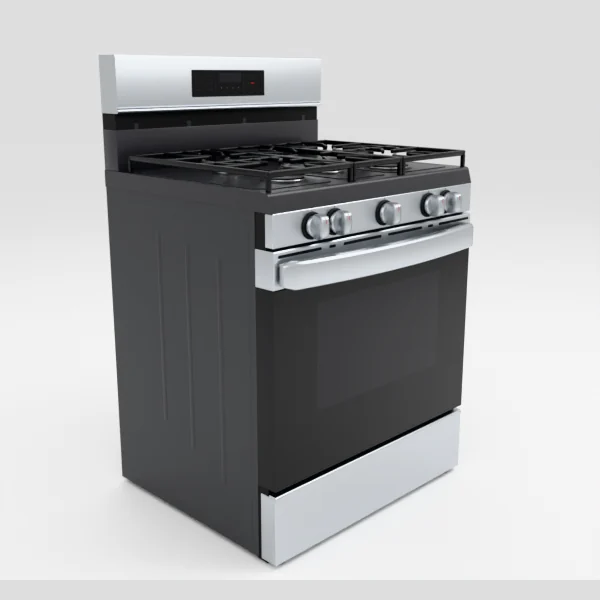
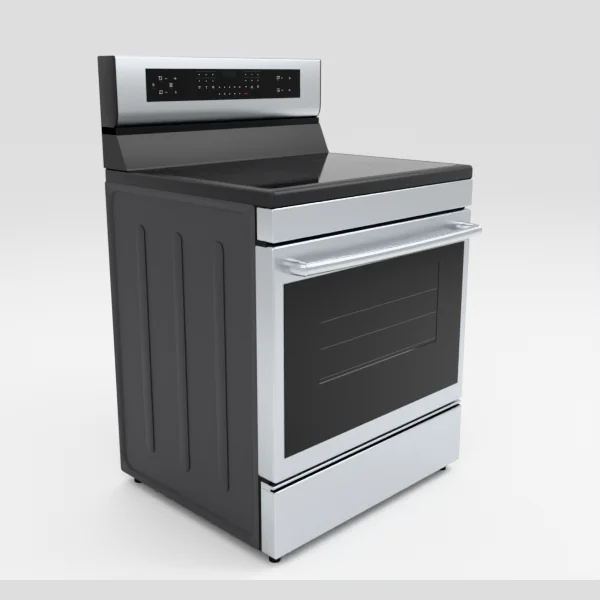
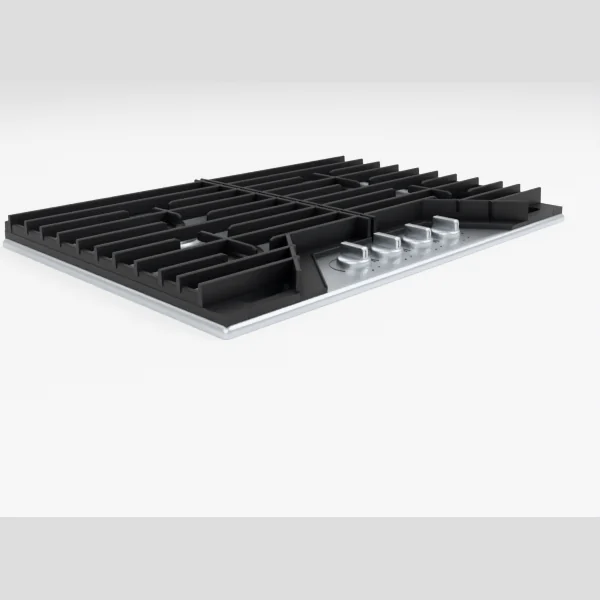
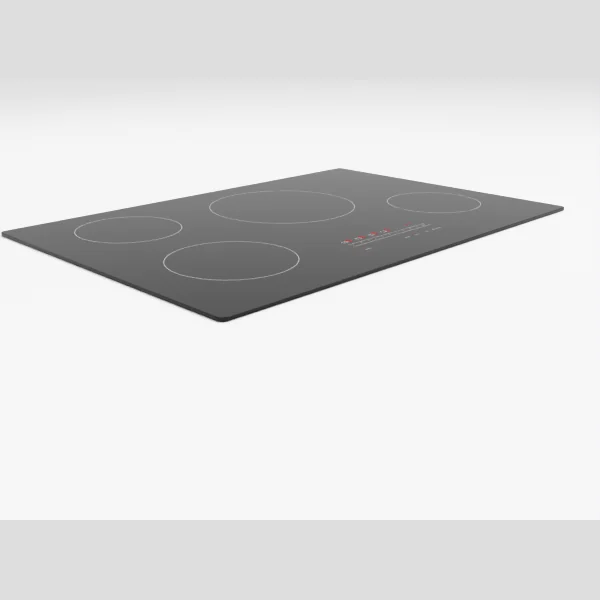
| Cooktop | Responds | Heat into the room | Cleaning | Pans | Behind the wall | Best for |
|---|---|---|---|---|---|---|
| Gas | At once; you see the flame | Most — heats the pan and the air round it | Grates and caps to lift and scrub | Any, including round-bottomed woks | Gas line and valve, a 120 V outlet, a hood ducted outside | Wok cooking, charring, cooks who work by eye |
| Induction | At once; power changes in the pan | Least — the heat is made in the pan | Flat glass; spills rarely burn on | Magnetic only — a magnet must stick | 240 V circuit to a receptacle or a hard-wired cable | Most new kitchens, families, small and condo kitchens |
| Radiant electric | Slowly, both up and down | In between; the glass stays hot afterwards | Flat glass, but spills bake on | Any flat-bottomed pan | 240 V circuit, the same as induction | Tight budgets, rentals, occasional cooking |
Read the table by its “behind the wall” column first: that is where the work is, and the one thing you cannot change later with a screwdriver. Note that induction and radiant share an entry. A kitchen wired for one electric top can almost always take the other.
No prices here on purpose — appliance prices move with the season and the sale. As a rule radiant electric is the least expensive smooth-top, induction costs more than radiant in the same format, and gas spreads across the whole range. Ask for the cost of the work behind the wall as well as the appliance; when you switch fuel, it is often the larger number.
Gas — and why the biggest burner matters least
Gas
Best for wok cooking, charring, and cooks who work by eye
A gas cooktop burns natural gas, or propane, in a ring of small flames under a cast-iron grate. An electric igniter lights it, a valve behind the knob sets the size of the flame, and you can see exactly what it is doing. That last part is why so many cooks love it: the heat is visible, it changes the instant you turn the knob, and it does not care what the pan is made of or whether its bottom is flat.
- Instant, visible control
- Any pan, including a round-bottomed wok
- On many models the top burners can be lit by hand in a power cut
- Puts combustion gases, heat and moisture into the room
- Grates and burners are the slowest top to clean
- Any new line or change is licensed gas work
Here is what the brochure leaves out. A gas flame does not just heat the pan; it wraps up round the sides of it, into the handle, the grate and the kitchen air. Lovely under a wok, wasteful under a small saucepan, and in August you feel it on your face.
“Gas” is also not one product. Four things separate a good one from a shiny one:
- The low end, not the high end. The showroom talks about the biggest burner. What you feel every day is whether the smallest one, turned right down, holds a pot of rice or a cream sauce without scorching it or going out. Look for a dedicated simmer burner, or one with a small inner ring
- Sealed or open burners. Nearly every home range has sealed burners on a pressed top, so a boil-over stays where you can wipe it. Some pro-style ranges use open burners over a spill tray; nobody likes cleaning them
- The grates. Continuous cast-iron grates let you slide a heavy pot between burners. They are heavy, and the enamel chips at the feet over the years. Check that each section fits in your sink
- The gas it is set up for. Ranges arrive set for natural gas. On propane, common at cottages, a gas technician converts it with the maker’s kit before it is lit
The honest trouble with gas is not the cooking. It is the air. Every burner is a small fire in the room: it turns gas and air into heat, water vapour and combustion gases, and on a cooktop all of it goes straight into the kitchen — there is no chimney. That is why gas needs a hood ducted outside more than any other cooktop does. A recirculating hood catches some grease and odour and does nothing about the burners’ exhaust or moisture. Run the hood every time a burner is lit, and use the back burners when you can; a hood catches them better. Ducted and recirculating hoods are compared on their own page.
The other quiet one: gas fitting is licensed work. Connecting a range, moving a valve, adding a line — a licensed gas fitter does it and tests for leaks. However short the pipe looks, it is not a weekend job. What needs a permit in Ontario is here.
None of that is a reason to avoid gas. It is a reason to buy the hood and duct as part of the range, and to have a carbon monoxide alarm in the house.
Induction — and why “induction” is not one thing
Induction
Best for most new kitchens, and for anyone who wipes a cooktop more often than they use a wok
Under the glass sits a flat coil of copper wire. When a magnetic pan is on it and the zone is switched on, the coil sets up a rapidly changing magnetic field, and that field makes the base of the pan heat itself. The glass is not the heater; it only gets warm from the hot pan sitting on it. Lift the pan off and the heating stops, and most cooktops switch the zone off on their own a little later.
- Responds as fast as gas; boils water fastest of the three
- Most of the heat goes into the pan, not the room
- Flat glass that stays cool enough for spills to wipe off
- Magnetic pans only
- Needs a 240 V circuit behind it
- Glass scratches, and some pans hum
People talk about induction as if it were one appliance. It is a family, and six things hide inside the word:
- Full power or plug-in. A built-in cooktop or full-size range runs on its own 240 V circuit, like an electric range. A plug-in hob of one or two zones runs from an ordinary 120 V outlet at a fraction of the power — fine for trying induction or an extra burner, not a replacement for a cooktop. A few full-size plug-in ranges are sold for homes without the heavy circuit; they are a niche, so read what they give up
- Zone size against pan size. The pan has to cover enough of the coil to be detected. A small saucepan on a big zone may not register; a wide pan on a small zone heats a disc in the middle. Hold your own pans against the circles
- Bridge and flex zones. A bridge joins two zones into one for a griddle; a flex zone finds the pan wherever you put it. Useful if you cook that way, decoration if you do not
- Power sharing. Zones usually share power in pairs, and the whole top has a ceiling. Boost one and its partner may quietly drop. Ask which zones share
- The hum. Some pans hum or buzz at high settings, especially multi-layer pans or bridged zones, and a cooling fan runs during and after cooking. Most people stop hearing it within a week; a few never do
- The magnet test. If a fridge magnet grips the bottom firmly, the pan works. Cast iron, enamelled steel and most stainless pass; plain aluminium, copper, glass and many ceramic pans fail unless a steel plate is bonded underneath. A round wok becomes a flat-bottomed one
And one more thing the word hides: the glass still scratches. It does not bake spills on, but a dragged cast-iron pan leaves a line, and a grain of salt under a pan acts like sandpaper. Lift, do not slide; the care page has the rest.
A built-in induction cooktop needs air. Its electronics are cooled by a fan that pulls air in and pushes it out, through slots by the glass or down into the cabinet below. Many installation sheets ask for a clear space under the cooktop or a vent in the cabinet, and a drawer of tea towels pressed against the underside can trip the overheat cut-out mid-dinner. That is a cabinet question, so the sheet comes before the base cabinet is ordered.
The second quiet one is the pans. People who switch from gas usually find their stainless passes, their aluminium non-stick fails, and the wok is what they miss.
Radiant electric — the smooth-top everyone has cooked on
Radiant electric (smooth-top)
Best when the budget is tight and the cooking is ordinary
Under the same ceramic glass are ribbon elements that glow red. They heat the glass, and the glass heats the pan. That is the whole difference from induction: the heat starts below the glass, not in the pan, so everything between element and food has to warm up first and cool down after.
- Least expensive smooth-top
- Works with any flat-bottomed pan
- Same supply as induction, so switching later is easy
- Slow to heat up and slow to cool down
- Glass stays hot after cooking; spills bake on
- Warped pans cook unevenly
Turn a radiant zone down and the pot keeps boiling for a while. Cooks who grew up on radiant move the pot off the zone instead, and switch off a minute early. It is a habit, not a flaw — but it makes radiant the least precise of the three.
Look for multi-ring elements, a bridge for a griddle, and a hot-surface light for every zone, because the top stays dangerous after it looks off. Baked-on spills are the daily weakness, and makers warn that sugar left to cool on hot glass can pit it, so it is scraped off promptly with a cooktop razor.
Radiant is the easiest fuel decision to undo. A kitchen wired for radiant can usually take induction later on the same circuit, without opening a wall. Check the new model’s sheet against the breaker — some induction ranges ask for a bigger circuit — and an electrician can tell you in minutes. Radiant now, induction later, is a sensible order.
Coil elements — open spirals in drip bowls — are the oldest and least expensive electric top: slow, fiddly to clean, close to indestructible, and each element unplugs for replacement. They use the same 240 V supply, so a coil range swaps for a smooth-top or induction in the same opening.
Where the heat goes, and how each one wears
The three tops make heat in three different places, and nearly everything else follows from that.
So, without anyone’s laboratory numbers: induction puts most of its heat into the pan; gas heats the room as well; radiant sits between and keeps heating the glass after you finish. How they age follows the same lines.
The first week. On gas you discover the simmer burner is the one that matters. On induction the boost setting boils a pot over before you are back from the fridge, and one pan hums. On radiant you learn to lift the pot rather than turn it down.
The first month. The gas grates need their first soak, and the habit of switching the hood on has either formed or not. Induction glass shows faint rings that a cream cleaner lifts. Radiant glass gets its first browned ring from a pasta boil-over.
A year in. Gas: a burner lights with a gap where food got into the ports, and the nearest cabinet feels tacky if the hood is weak. Induction: fine scratches round the busiest zone, visible in low light. Radiant: a grey haze round the big element, and a ring that no longer comes off.
Ten years on. On gas the burners are usually fine; igniters that will not stop clicking are the common repair. On induction the parts that wear are electronic — the control board and the fan. On radiant an element can burn out and is replaced on its own. On both glass tops, a cracked glass from a dropped pot is the big repair.
And under a hand: gas grates stay hot long after the flame is off; a radiant top is too hot to touch across the whole circle for minutes; an induction top is warm only where the pan sat.
Freestanding, slide-in, or a cooktop and a wall oven
Fuel is one question. The shape of the appliance is another, and it cuts straight across the first: all three fuels come in each of these. For the cabinets and the counter, the format matters more than the fuel.
- Freestanding range. Finished sides, usually a back guard with the controls, and it slots into the 30″ gap. The counter stops at each side, leaving a crumb gap. The least expensive format, the easiest to swap, and the only one that can stand at the end of a run
- Slide-in range. No back guard, controls at the front, and a top that overlaps the countertop edges either side, so there is no crumb gap and the backsplash runs behind it. The sides are usually unfinished, and the counter is cut to suit the exact model. A front-control freestanding range splits the difference
- Cooktop and wall oven. The cooktop drops into a counter cutout over a 30″ or 36″ base; the oven goes into a tall cabinet where nobody has to bend. Two appliances means two connections, and whether one circuit can feed both is the electrician’s call. It costs a tall cabinet’s worth of wall, and it is the usual route for an island cooktop
- Dual fuel. A gas top over an electric oven. It needs both a gas valve and a 240 V circuit behind it
Then there is size. A 36″ or 48″ pro-style range is a different kitchen: a wider opening, a bigger hood, more air to move on gas, and sometimes more clearance to the cabinets beside it. Decide that before the cabinets are ordered. Cooktops in islands have their own page.
What switching fuel really costs — in work, not money
What they search at midnight “switching from gas to induction” — the range is the easy part; the circuit is the job.
Switching fuel is not an appliance decision; it is a small renovation with a trade at each end.
From gas to induction or radiant electric. An electrician runs a new 240 V circuit: a heavy cable, a double breaker, and a receptacle or junction box. Whether the panel has room, and whether the house’s service can carry one more large load, is a calculation the electrician makes on site. Sometimes it is a simple addition; sometimes it means a new panel, occasionally a larger service. Get that answer before you buy the range. On the gas side, a licensed gas fitter caps the line and removes the old connector; if the furnace still runs on gas, the meter stays.
From electric to gas. A gas fitter runs a line from the nearest supply, usually up through the floor, with a shut-off valve where it can be reached, and the range needs an ordinary 120 V outlet too. With no gas service at all, the job starts with the utility. The hood comes with it: if there is no realistic path for a duct outside, that is a strong argument for staying electric.
In a condo. Many suites have no gas, and new circuits or ducts through an outside wall go through the building first. What a condo will let you do usually settles the fuel before you reach a showroom.
The cheapest moment for any of it is when the walls are open, before the cabinets — the argument of the renovation order page. If they are open anyway, ask both trades what it would take to rough in the other option too.
What the fuel changes in the cabinets and the counter
For the cabinets, the fuel changes less than people fear. The appliances chapter has every range number; here is how they fall by fuel.
- The opening. Any standard range drops into a 30″ gap. Leave it a true 30″, because ranges are built a whisker under
- A slide-in and the counter. The top overlaps the countertop, so the counter is cut to that exact model. With quartz, the fabricator templates after the range is chosen
- A cooktop’s cutout. Always smaller than the cooktop, and taken from the model’s sheet. A fabricator rounds its inside corners, keeps seams out of it, and leaves enough stone in front and behind. Flush-mounted cooktops need a routed ledge — decide before templating
- What goes underneath. Gas has a burner box and connection hanging down, electric a junction box, induction its body and its need for air. Most rule out a full drawer stack; the usual answer is a false front over a shallow drawer, or an oven the maker approves
- The hood height. From the cooking surface to the bottom of the hood: 24–30″ above gas, 20–24″ above electric or induction. A plain cabinet needs 30″, or 24″ with its underside properly protected. Switch fuel and the cabinet above the hood can move too
- Heat beside the range. During a self-clean cycle the cabinets either side get very warm. Thermofoil doors and end panels — a vinyl skin over MDF — can bubble or peel from it, which is why heat shields exist. Some ranges list side clearances; the sheet says
One counter habit belongs here. Quartz is bound with resin, so a pan straight off a burner or out of the oven goes on a trivet, not on the stone. Quartz and granite are compared on their own page.
Whichever fuel you choose, these six habits matter more than any feature:
Decide the fuel before the cabinets are ordered. It sets the hood height, the cabinet above, and what the trades rough in. Get the exact model’s spec sheet — cutout, clearances, and the zone where the services go — and plan from it. Put the outlet and the gas valve where the range does not sit on them, inside the area the sheet shows, often reachable through the storage drawer. Fit the anti-tip bracket, every time, on every range. Leave the 30″ opening a true 30″, plumb and square. Plan the hood with the fuel — height, duct route and cabinet above — the day you choose the range.
Five things the fuel does not decide
A lot of the heat in this argument comes from blaming the fuel for things it has nothing to do with.
- The size of the opening. All three come as a standard 30″ range between the same cabinets.
- How well the oven bakes. That is the oven. Gas ranges usually have gas ovens, dual-fuel ranges electric ones, induction and radiant ranges ordinary electric ovens. Judge the oven on its own.
- Whether you need a hood. All three do. Grease, steam and smoke come off the food; gas adds its own exhaust on top.
- How the kitchen looks. That is the format, the hood and the backsplash. Two slide-ins of different fuels look more alike than a slide-in and a freestanding range of the same fuel.
- Which counter you can have. Quartz, granite and porcelain all take any of them. What matters is the cutout, the trivet and how each surface handles heat.
And one piece of language to watch for: “professional” or “pro-style”. It describes a look — heavy knobs, stainless, chunky grates. On gas it may also mean high-output or open burners that need a bigger hood and more clearance. Ask what, exactly, is professional about it.
How to shop for a range when nothing on the floor is plugged in
Most showroom ranges are not connected, so you cannot taste the difference. Bring things instead: a fridge magnet and your two most-used pans for the induction zones, and photos of the wall behind your range and the breaker labels. Lift a grate. Then ask the questions that tell you more than the badge:
- Can I have the installation sheet for this exact model number? — not the series; the page with the cutout, the clearances and the service zone
- Where on the wall must the valve or receptacle be? — so the range sits flat against the wall
- What circuit does it need, and does it come with a power cord? — for your electrician
- Which zones share power, and what is the smallest pan each will detect? — for induction
- What is the lowest setting on the smallest burner? — for gas
- What can go in the cabinet underneath? — for a cooktop
- What clearance does it need at the sides and above? — to cabinets and to the hood
- Can it be converted to propane, and who supplies the kit? — if you run on propane
Flip sells kitchen cabinets and engineered-quartz countertops — not ranges, cooktops or hoods — so we meet the range when it arrives and have no reason to prefer a fuel. The failures seen from the cabinet side are almost never about cooking. A cooktop cutout planned before anyone had the model’s sheet. A three-drawer base ordered for the spot under a cooktop that needed the space. A wall cabinet and hood set at the electric height over what became a gas range. A slide-in range chosen after the counter was templated for a freestanding one.
All four show on a plan. Our free planner has ranges and cooktops in the common sizes to drop in: put a range in the base run or a cooktop in the counter, draw the countertop with its cutout, and see the hood and cabinets above it in 3D. It will not choose your fuel; it will show whether the kitchen around your choice works. The other layout mistakes are here.
What we would do, kitchen by kitchen
General rules are easy. Here is how the choice actually falls for the kitchens people really have.
A family house you plan to stay in. Induction, if the panel can carry it: fast, cooler, wipe-clean, and a zone stops heating when the pan comes off, which matters with small children about. If gas is already there and the wok comes out most nights, gas — under a ducted hood you will actually switch on. Decide before the cabinets are ordered.
A condo. Induction, or radiant on a budget. Most suites have no gas, and where there is gas a duct outside is often impossible, leaving gas under a recirculating hood — the combination this page warns about.
A basement suite. A freestanding radiant smooth-top. Least expensive, any flat pan works so a tenant’s cookware is never the problem, and the circuit takes induction later.
A cottage. On propane already, a gas range converted by a gas technician keeps cooking when a storm takes the power — on many models the top burners can be lit by hand. All-electric, radiant or coil is simple and forgiving; induction means a second set of pans.
A rental you own, or a house you are fixing to sell. Keep whatever the wall already feeds and spend on the format: a slide-in or front-control range with the backsplash behind it looks planned. Buyers judge the look and the hood, not the fuel.
A small kitchen. Induction: no flame near a tea towel, a room that stays cool, and cool glass that reads as a little more counter. If the wall is short, 24″ ranges exist; the small-kitchen guide shows where one goes in a galley.
Someone who cooks hard every day. A round wok and high heat: gas, under the best ducted hood the wall allows. Precise everyday cooking — sauces, searing, pasta for six: induction does it faster, with a flat-bottomed wok. Either way, plan the opening and hood first.
- No gas in the building, or no way to duct a hood outside. Induction, or radiant on a budget.
- A round wok, charring, cooking by the flame. Gas, under a hood ducted outside.
- Small children, or the cooktop doubles as counter. Induction.
- A tight budget and ordinary cooking. Radiant smooth-top, wired so induction can follow.
- A propane cottage where the power goes out. Gas, converted to propane.
- Switching from gas. Induction, after an electrician has looked at the panel.
If you are keeping the range you have
Most people reading this are not buying a range this month. An hour on a Saturday makes the one you have safer and easier on the cabinets — and answers most questions about the next one.
- Check the anti-tip bracket. Pull the storage drawer and look at the back feet with a flashlight. A back foot should sit under a bracket. If there is none, the maker sells one; it is a four-minute job.
- Clean the burners and look at the flame. On gas, lift the caps, clear blocked ports with a pin, and dry everything. A healthy flame is blue and even all the way round; if it stays yellow or lifts after cleaning, call a gas technician. If you smell gas, leave and call from outside.
- Test the hood. On high, it should pull a square of paper towel up and hold it. Then find the flap outside. No flap anywhere means it recirculates, and its charcoal filter is probably overdue.
- Find the shut-offs and the alarm. Find the gas valve or the range breaker, and label it. If anything in the house burns gas, test the carbon monoxide alarm.
- Do the magnet test. Even if induction is years away, magnet every pan you own. It turns a vague future cost into a short list.
- Look at the cabinet beside the range. Wipe the nearest cabinets with warm soapy water and dry them. Check thermofoil doors near the oven for bubbles or lifting edges; a heat shield stops it getting worse.
The neighbouring choices are waiting too: which hood goes above it, which stone goes around it, which doors go beside it, and every range and hood number in the appliances chapter.
Straight answers
Is induction better than gas?+
For most home kitchens, yes. Induction responds as quickly as gas, boils water faster, puts most of its heat into the pan instead of the room, and wipes clean because spills rarely burn onto the glass. Gas is still the better tool for round-bottomed woks and charring over a flame, and it works with any pan. Gas also needs a hood ducted outside more than induction does.
Is an induction cooktop worth it?+
Usually, if the house already has, or can take, a 240 V circuit behind the range and you are willing to check your pans with a magnet. The cooking is fast and precise, the kitchen stays cooler and the glass is easy to keep clean. It is less worth it where the electrical panel would need upgrading for one appliance, or where most of your cookware is aluminium or copper.
What is the difference between induction and electric cooktops?+
Both are usually flat glass on a 240 V circuit. A radiant electric cooktop has glowing elements under the glass that heat the glass, which then heats the pan, so it is slow to warm up and slow to cool down. An induction cooktop uses a magnetic field to make the pan heat itself, so it responds almost instantly and the glass stays much cooler.
Do you need special pans for induction?+
You need pans with a magnetic base. Hold a fridge magnet to the bottom: if it grips firmly, the pan works. Cast iron, enamelled steel and most stainless pans with a magnetic base pass. Plain aluminium, copper, glass and many ceramic pans do not, unless a steel plate is bonded underneath. Flat bottoms work best, and a wok needs a flat base.
Does an induction range need a special outlet?+
A full-size induction range or built-in cooktop needs a dedicated 240 V circuit, the same kind an electric range uses, ending in either a heavy-duty receptacle behind the range or a cable wired directly into the appliance. If you are replacing an electric range, the existing circuit may be enough; check it against the new model’s sheet. Coming from gas, an electrician has to run the circuit.
Is a gas stove bad for indoor air?+
A gas burner releases combustion gases and water vapour into the kitchen along with its heat, and a cooktop has no chimney to carry them away. That is why gas needs a range hood ducted outside, switched on every time a burner is lit. A recirculating hood catches some grease and odour but does not remove the burners’ exhaust. Homes with gas appliances should also have a carbon monoxide alarm.
Why does my induction cooktop buzz?+
A low hum or buzz usually comes from the pan, not a fault: pans built from several bonded layers vibrate in the magnetic field, especially on high settings or when two zones are bridged. Turning the power down usually quietens it, and a heavier, flat pan often stops it. A soft whir during and after cooking is the cooling fan for the electronics, and it is normal.
Do induction cooktops scratch?+
Yes. The glass is the same kind of ceramic glass used on radiant cooktops, and dragging a cast-iron pan, or grit trapped under any pan, leaves fine scratches. It does stay cleaner than radiant glass, because the glass is warmed only by the pan and spills rarely bake on. Lift pans rather than sliding them, and clean with a cream cleaner made for glass cooktops.
What is the difference between a slide-in and a freestanding range?+
A freestanding range has finished sides and usually a back guard, and simply slots into a 30″ gap between cabinets. A slide-in has no back guard, its controls are at the front, and its top overlaps the countertop edges beside it, so there is no crumb gap and the backsplash runs behind it. The counter must be cut to suit the exact model.
How high should a range hood be over gas versus induction?+
Measured from the cooking surface to the bottom of the hood, 24–30″ above a gas cooktop and 20–24″ above electric or induction. Gas sits higher because the flame and its hot exhaust rise further. Follow the hood’s own manual where it differs. A plain cabinet needs more: 30″ above the cooking surface, or 24″ where its underside is properly protected.
Plan the hood with the fuel.
Drop a range or cooktop into your plan in the free 3D planner, draw the counter and its cutout around it, and see the hood and the cabinets above it before anything is ordered.
Open the 3D planner →